Back to Product & Strategy

Product case study

ShareChat Kreator

Making content creation easier for regional-language users.

A growth product case exploring how AI-assisted text, image and video creation could reduce content-creation friction for users who are more comfortable in regional languages.

  • Product Strategy
  • User Research
  • Growth
  • AI / LLM
  • Regional Languages
  • UX Design
user interviews
12
solution directions
3
Kreator priority score
243
generative content modes
3

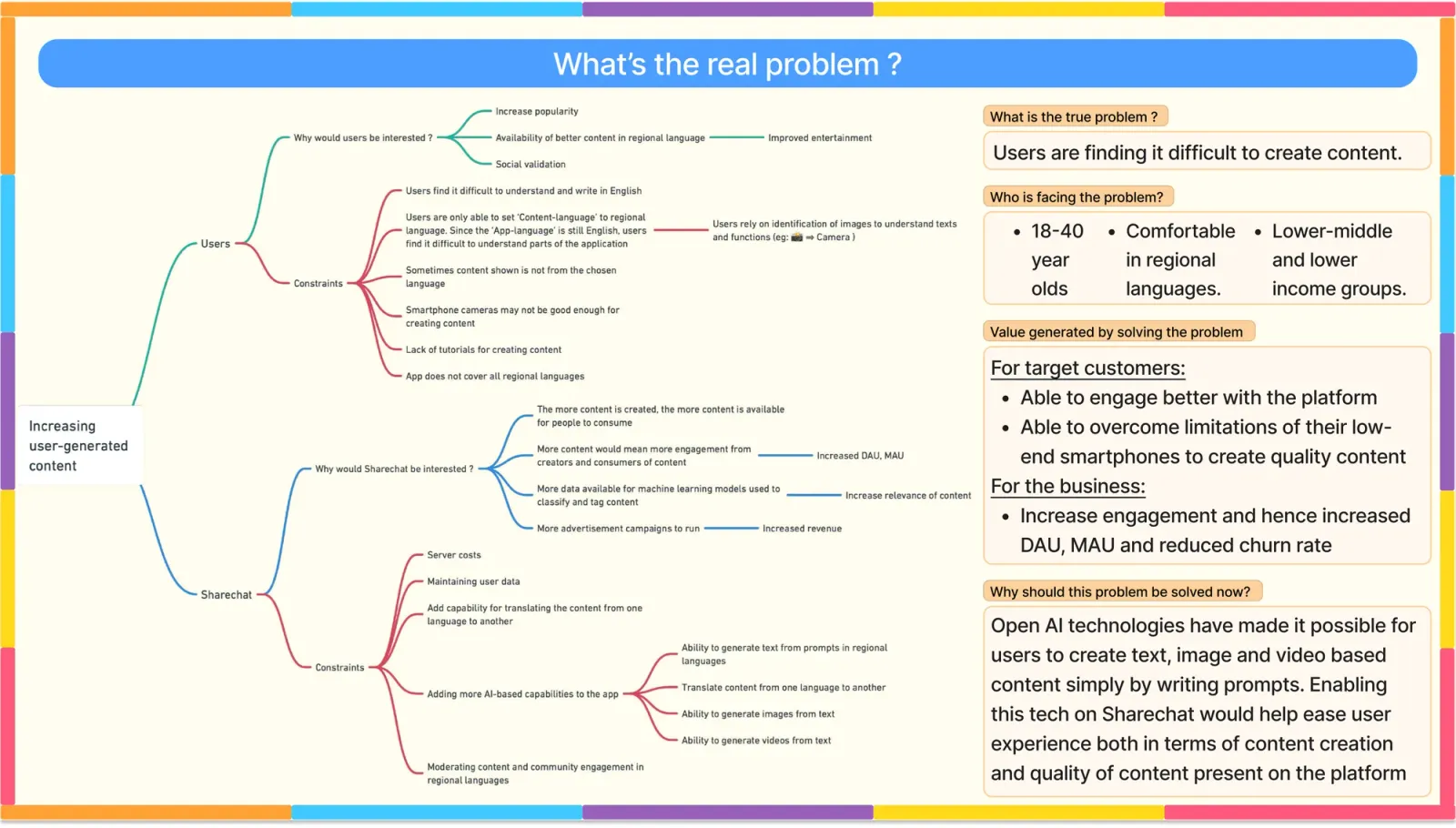
Slide 3, What's the real problem? Users are finding it difficult to create content. Who is facing the problem: 18 to 40 year olds, comfortable in regional languages, from lower-middle and lower income groups. Value generated by solving the problem: for target customers, being able to engage better with the platform and overcome the limitations of low-end smartphones to create quality content; for the business, increased engagement and hence increased DAU and MAU and a reduced churn rate. Why now: OpenAI technologies make it possible for users to create text, image and video content simply by writing prompts.
Slide 3Open in deck (opens in a new tab)
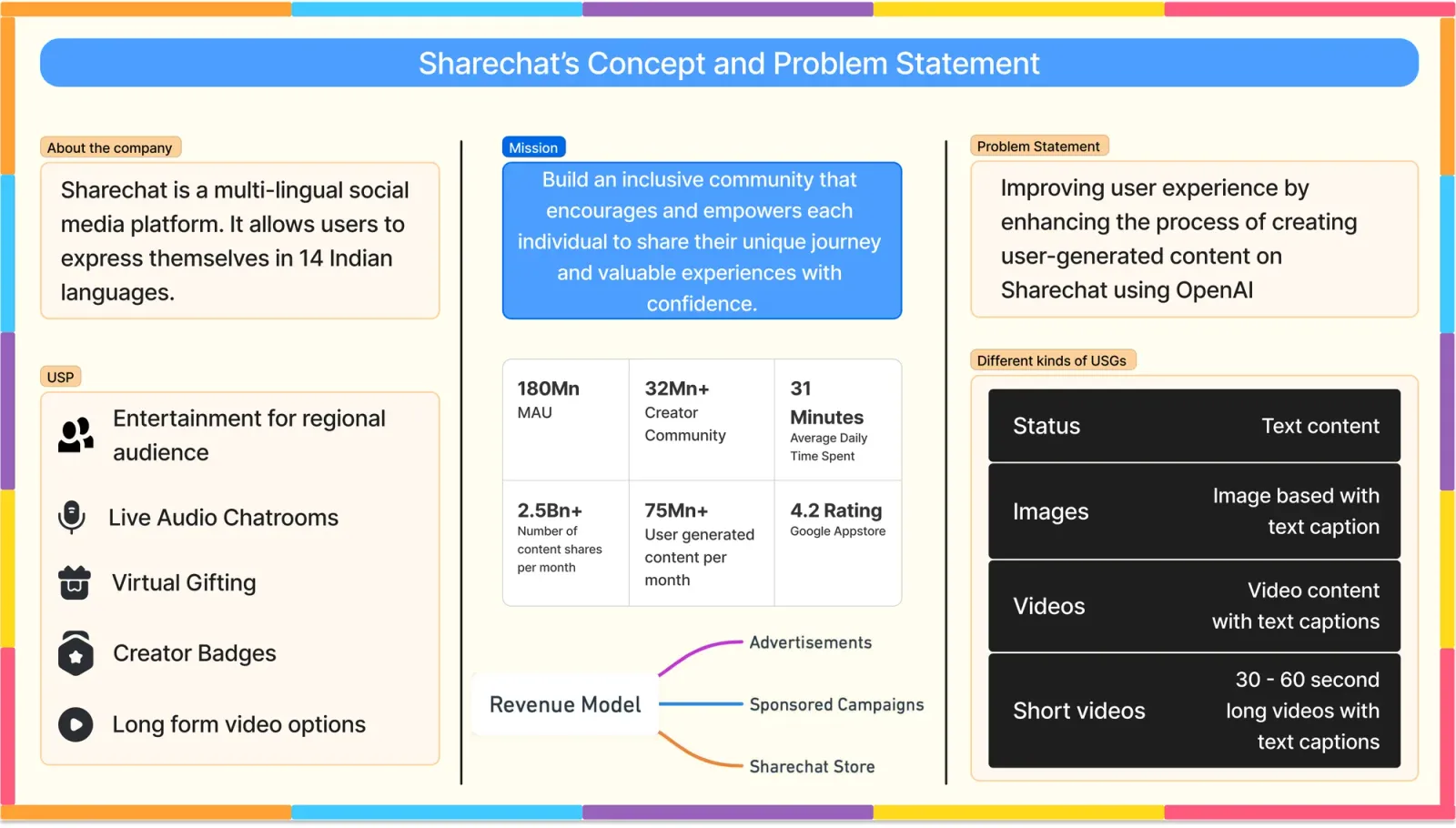
Slide 2, ShareChat's concept and problem statement. ShareChat is a multilingual social media platform that lets users express themselves in 14 Indian languages. Features: live audio chatrooms, entertainment for a regional audience, virtual gifting, creator badges and long-form video. Mission: build an inclusive community that encourages and empowers each individual to share their unique journey and experiences with confidence. Problem statement: improve user experience by enhancing the process of creating user-generated content on ShareChat using OpenAI. Content types: status text, images, image with a text caption, videos, and short videos of 30 to 60 seconds. Reported figures: 180 million MAU, 32 million plus creators, 31 minutes average daily time spent, 2.5 billion plus content shares a month, 75 million plus user-generated content a month, and a 4.2 Google rating.
Slide 2, contextCompany figures are as reported in the deck and are not verified here.Open in deck (opens in a new tab)

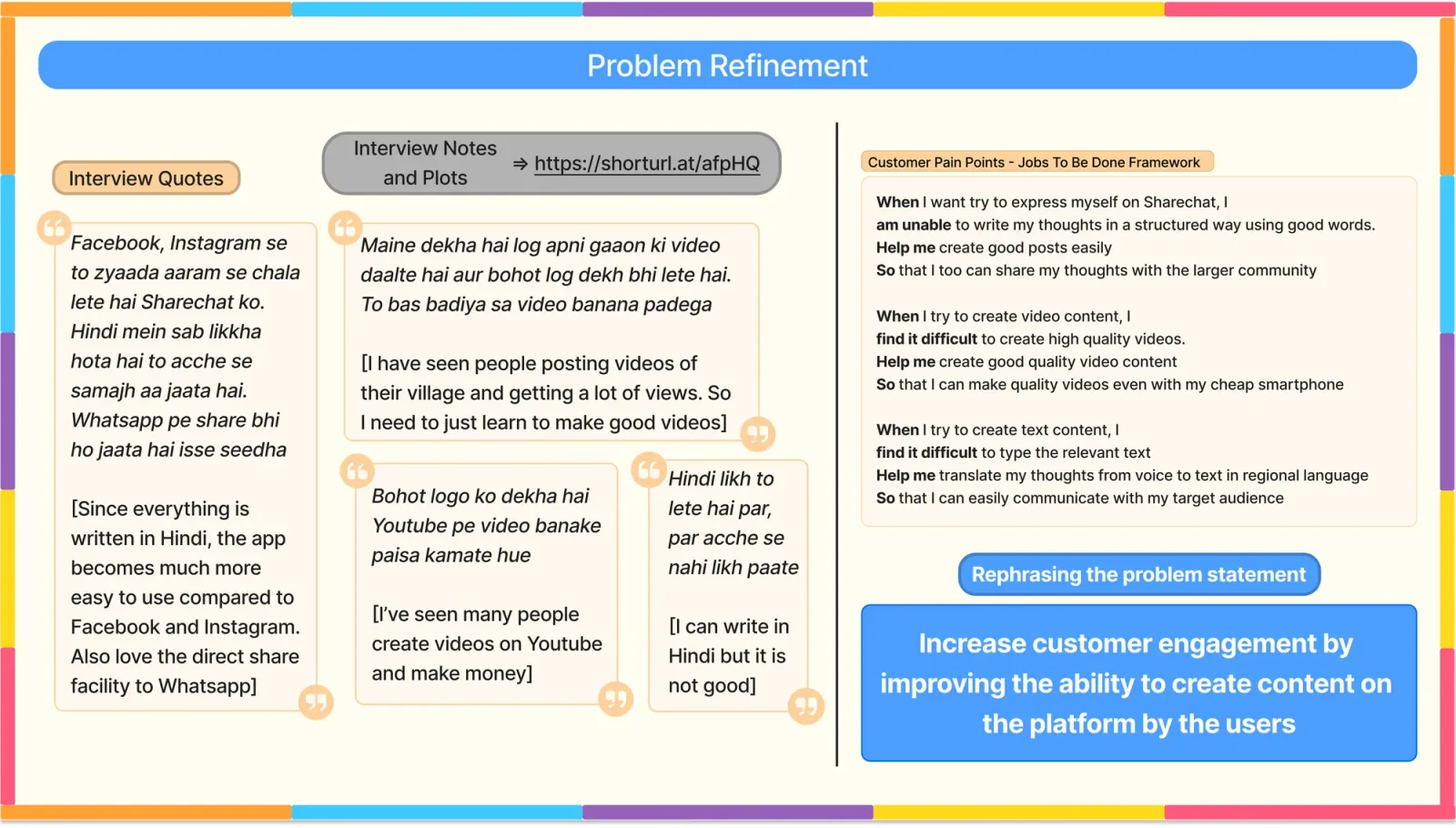
The interview sheet adds one detail the deck does not: only 4 of 12 interviewees could write in English.
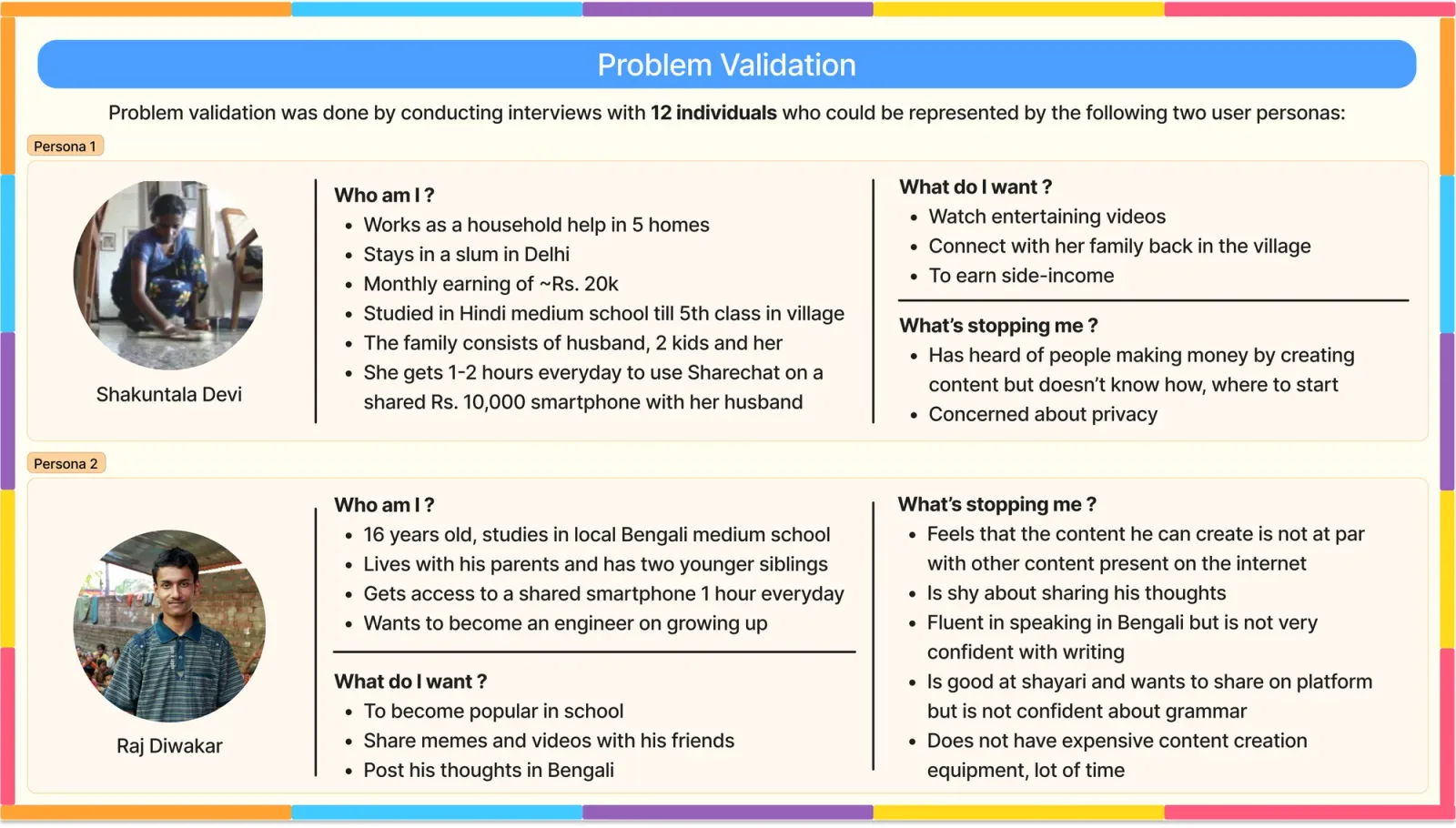
Slide 4, Problem validation. Validation was done through interviews with 12 individuals represented by two personas. Persona 1, Shakuntala Devi: works as a household help in 5 homes, stays in a slum in Delhi, earns about Rs. 20k a month, studied in a Hindi-medium school till 5th class in her village, family of husband, 2 kids and herself, gets 1 to 2 hours a day on ShareChat on a shared Rs. 10,000 smartphone. She wants to watch entertaining videos, connect with her family back in the village, and earn side income. What stops her: she has heard of people making money by creating content but does not know how or where to start, and she is concerned about privacy. Persona 2, Raj Diwakar: 16, studies in a local Bengali-medium school, lives with his parents and two younger siblings, gets a shared smartphone for 1 hour a day, wants to become an engineer. He wants to become popular in school, share memes and videos with friends, and post his thoughts in Bengali. What stops him: he feels the content he can create is not at par with other content on the internet, is shy about sharing his thoughts, is fluent in Bengali but not confident writing it, is good at shayari but not confident about grammar, and lacks expensive equipment and time.
Slide 4Open in deck (opens in a new tab)

Counts from the interview sheet

Recomputed from the interview notes sheet the deck links to. Individual respondents are not shown.

Smartphone issues
  • Understanding SMS content10/12
  • Phone lag9/12
  • Slow internet7/12
  • Navigation6/12
  • Bad camera5/12

Respondents naming each issue. “Understanding SMS content” is the sheet’s own label.

Content-creation issues
  • Text content6/12
  • Image content4/12
  • Editing images4/12
  • Image quality4/12
  • Privacy concerns4/12
  • Grammar3/12
  • Editing video2/12

Respondents naming each issue while creating content.
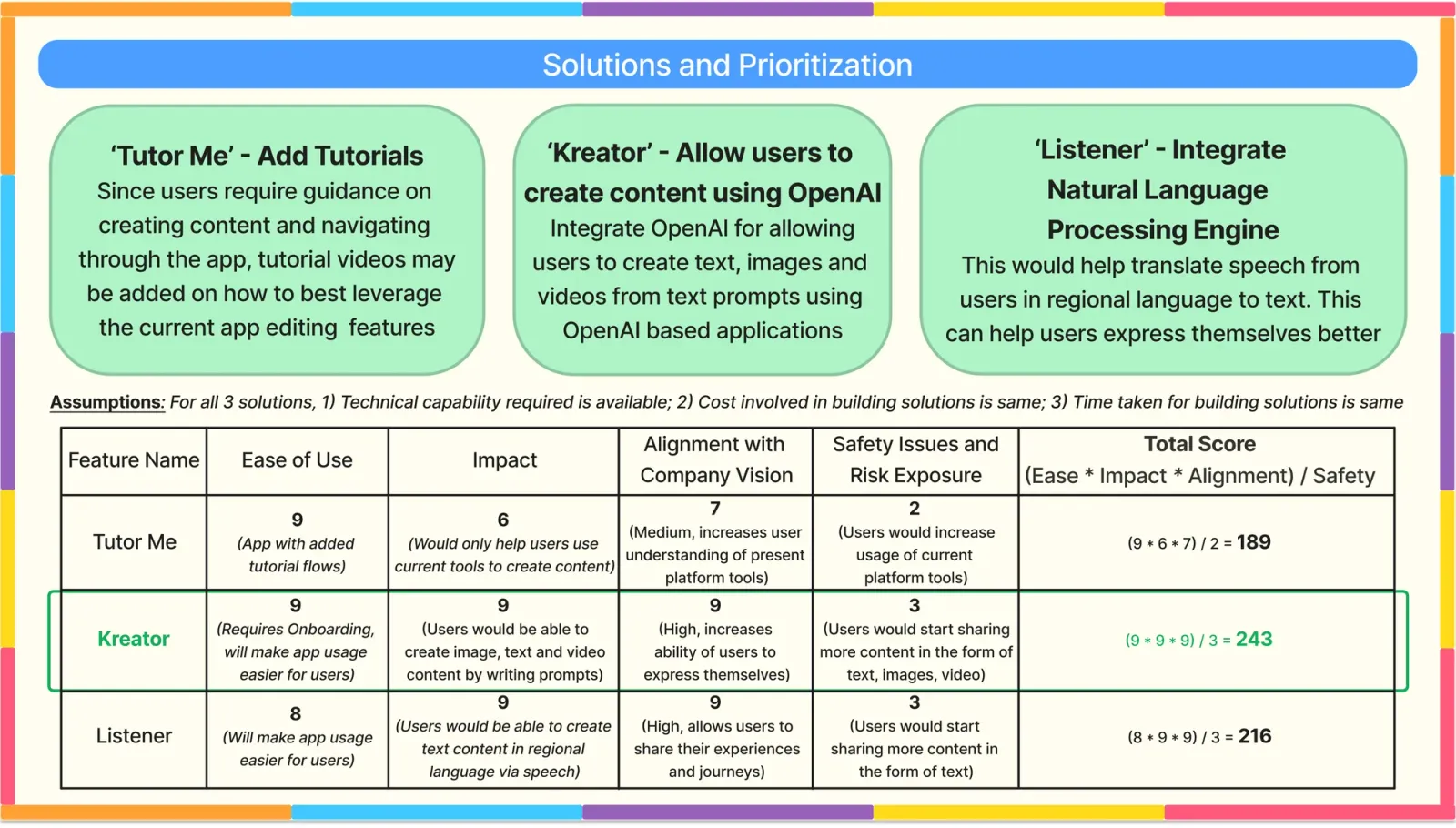
Slide 6, Solutions and prioritization. Three solutions. Tutor Me: add tutorials, since users need guidance on creating content and navigating the app. Kreator: allow users to create text, images and videos from text prompts using OpenAI. Listener: integrate a natural language processing engine that translates speech in a regional language into text. Assumptions for all three: technical capability is available, and cost and build time are the same. Scoring is (Ease of use times Impact times Alignment with company vision) divided by Safety issues and risk exposure. Tutor Me: ease 9, impact 6, alignment 7, safety 2, total 189. Kreator, highlighted as the chosen option: ease 9, impact 9, alignment 9, safety 3, total 243. Listener: ease 8, impact 9, alignment 9, safety 3, total 216.
Slide 6Scores are the case author's own judgments, not measured data. Kreator, at 243, is the chosen direction.Open in deck (opens in a new tab)

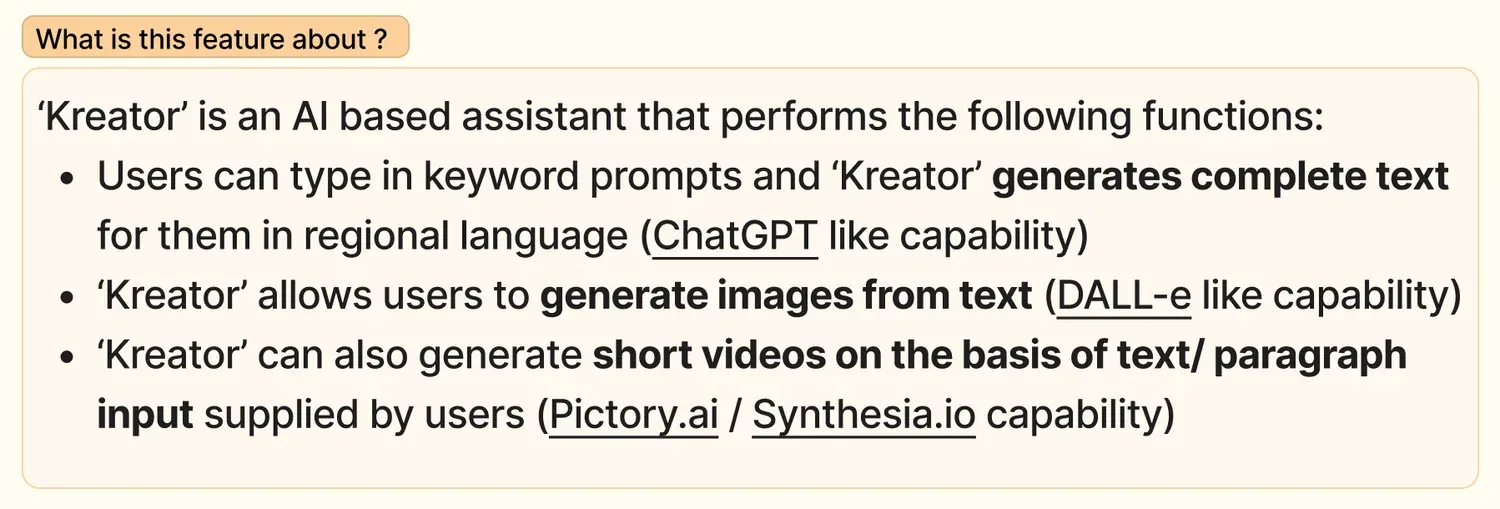
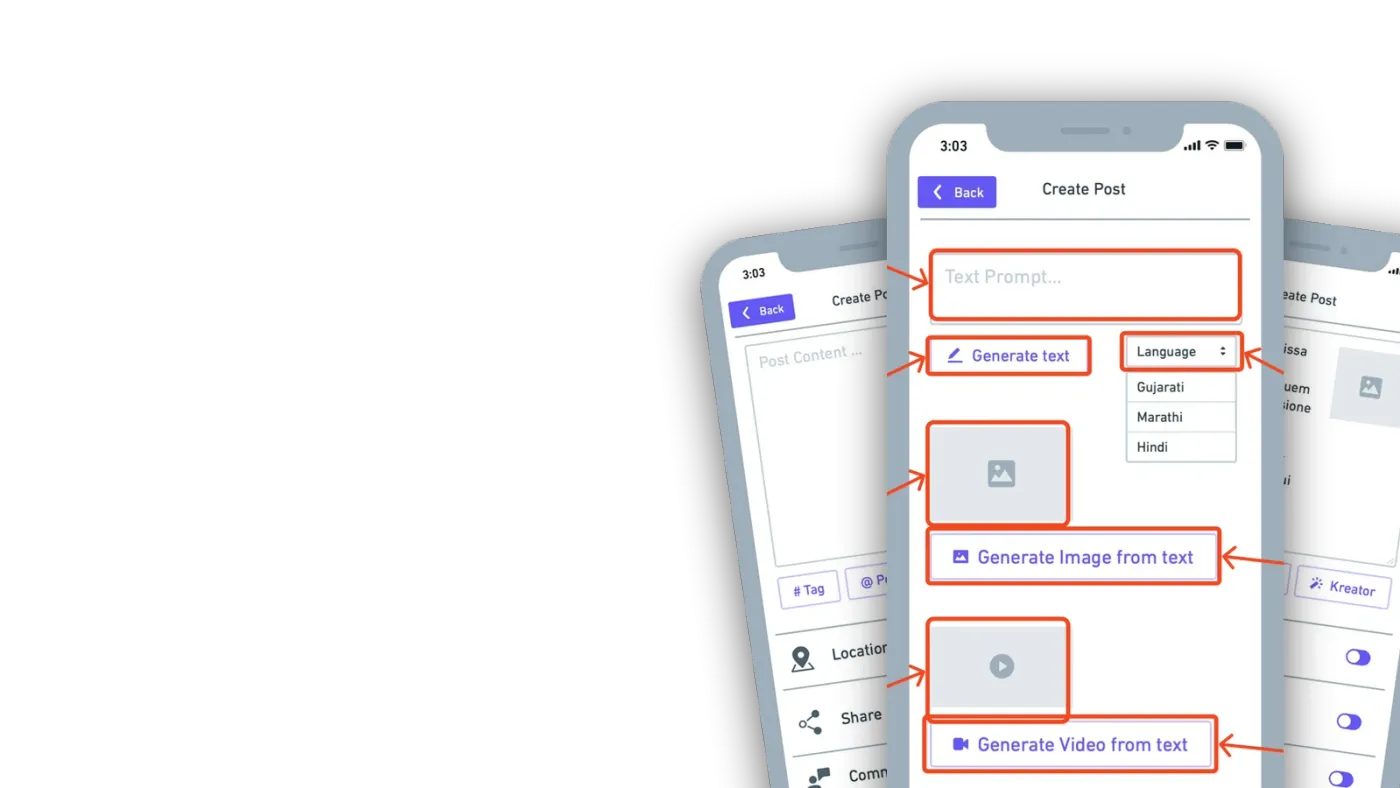
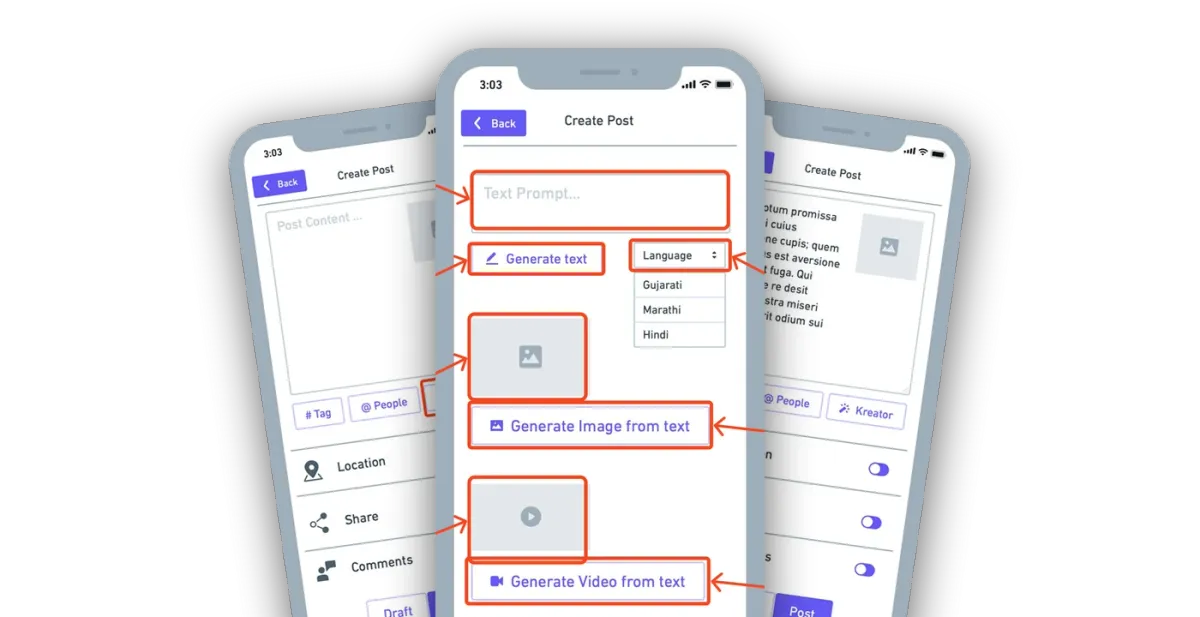
What is this feature about? Kreator is an AI based assistant that performs three functions. Users type keyword prompts and Kreator generates complete text for them in a regional language, a ChatGPT-like capability. Kreator lets users generate images from text, a DALL-E-like capability. Kreator can also generate short videos from text or paragraph input, a Pictory.ai or Synthesia.io capability.
Slide 7, the featureOpen in deck (opens in a new tab)
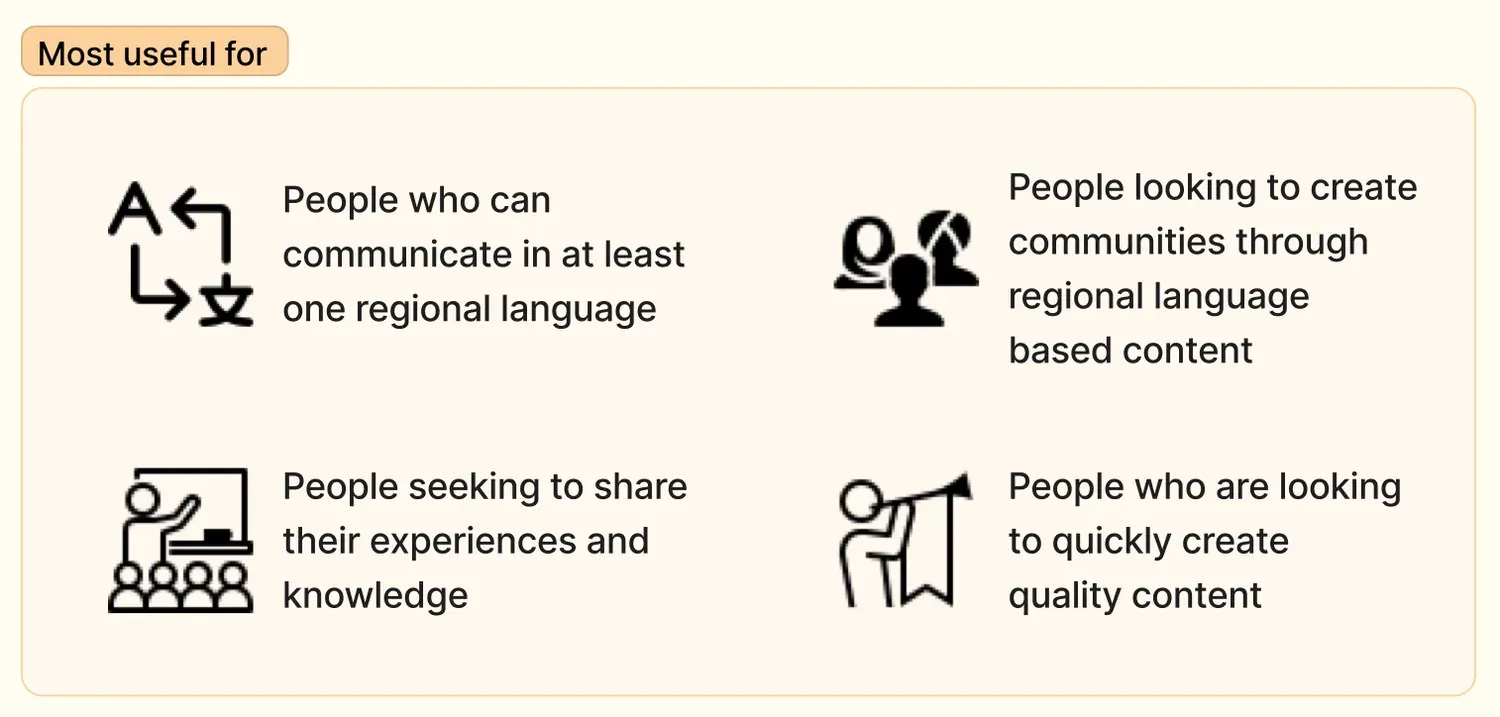
Most useful for four groups: people who can communicate in at least one regional language; people looking to create communities through regional-language based content; people seeking to share their experiences and knowledge; and people who are looking to quickly create quality content.
Slide 7, most useful forOpen in deck (opens in a new tab)

Interactive prototype

Concept flow: create, generate, preview

Slide 8's three wireframe screens: enter Kreator from Create Post, generate text, an image or a video from a prompt, then preview the post.

Open in Figma (opens in a new tab)

1 / 3

Step 01

Enter Kreator

The Create Post screen gains one new control: a Kreator button next to # Tag and @ People, which opens Kreator mode.

  • NewKreator button below the post box
  • UnchangedPost content, # Tag, @ People, Location, Share, Comments
  • ActionsDraft and Post

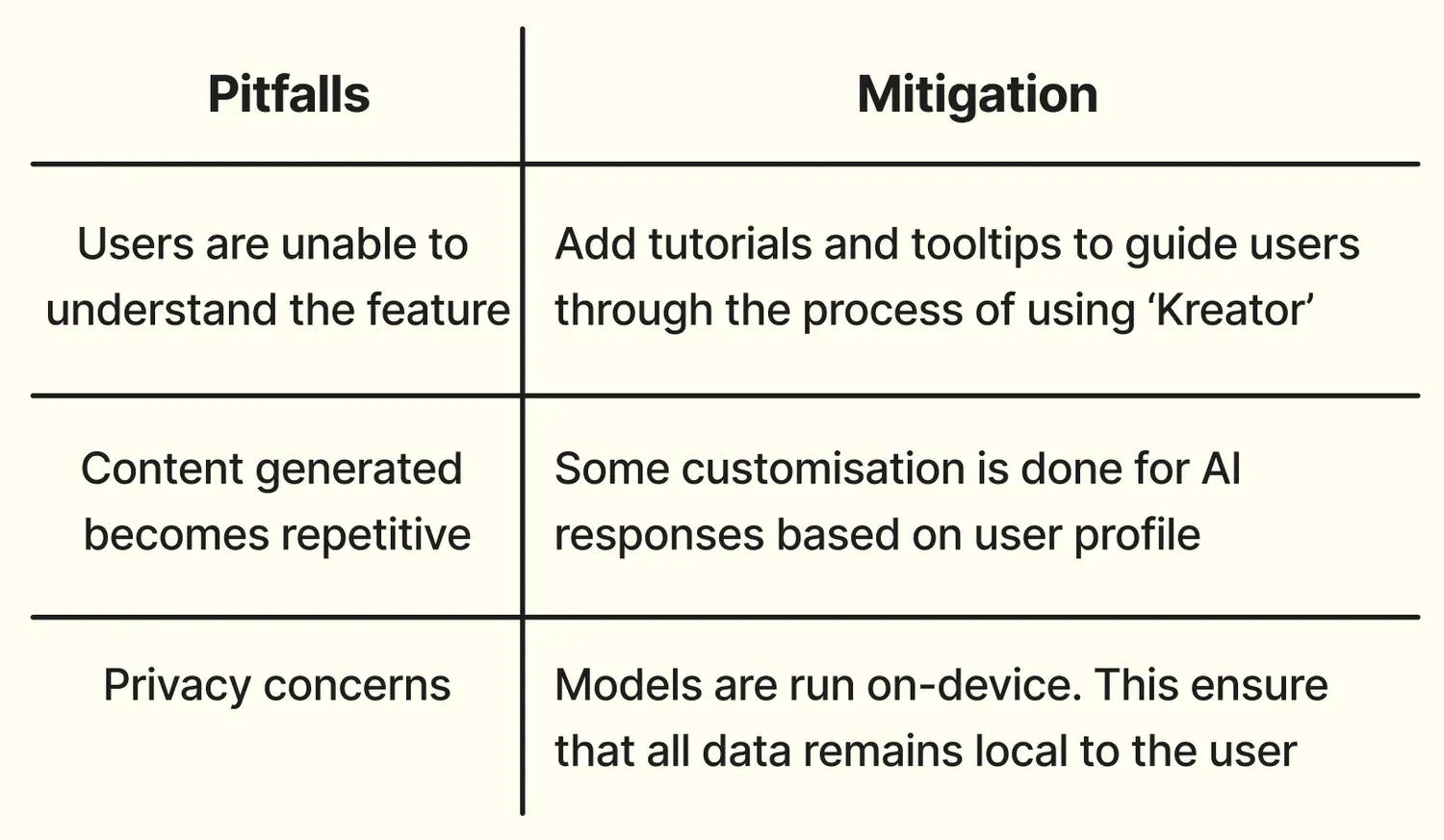
Pitfalls and mitigations. Users are unable to understand the feature: add tutorials and tooltips to guide users through using Kreator. Content generated becomes repetitive: some customisation of AI responses based on the user profile. Privacy concerns: models are run on-device so that all data remains local to the user.
Slide 7, pitfallsOn-device execution is a proposal from the case; whether these models could run on-device is not established here. 4 of 12 interviewees raised privacy concerns.Open in deck (opens in a new tab)
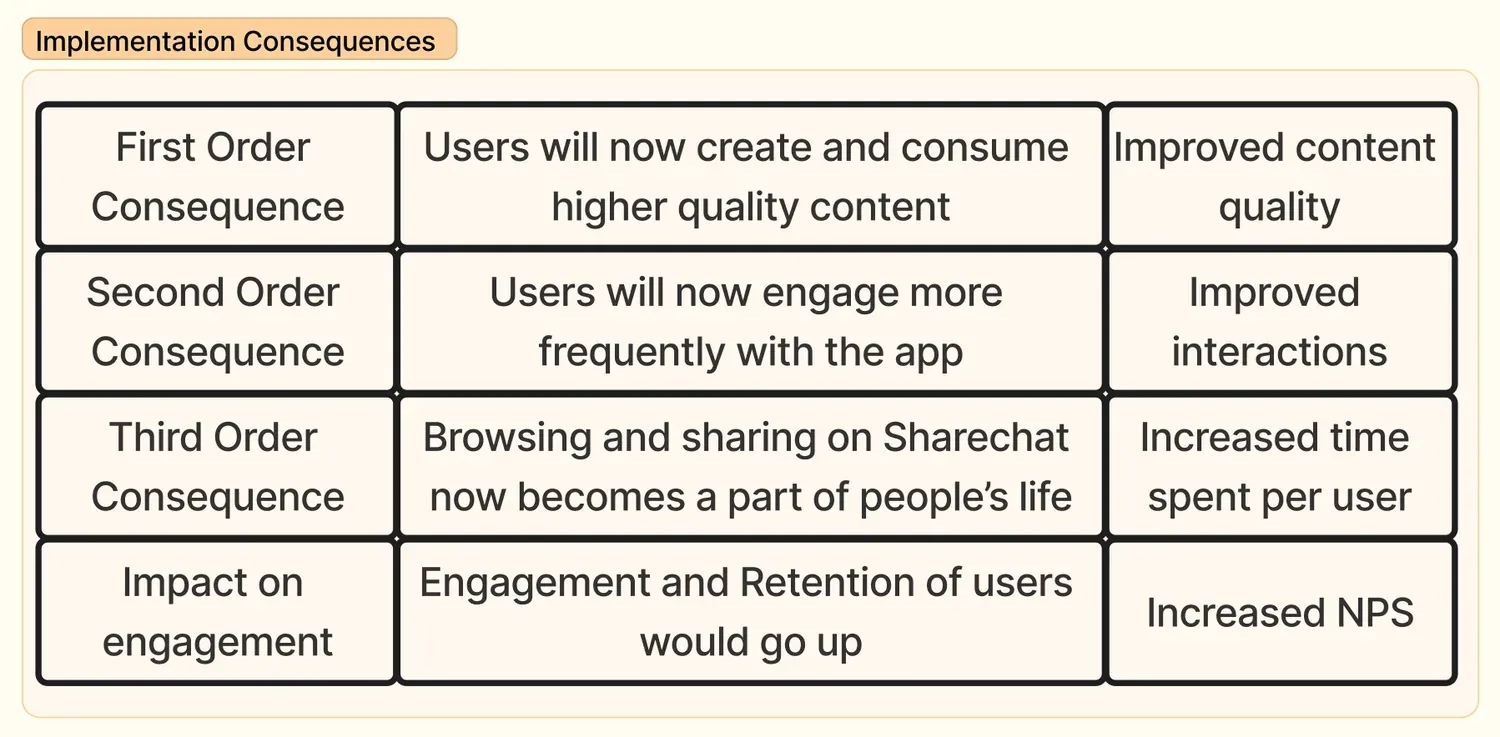
Implementation consequences. First order: users will create and consume higher quality content, giving improved content quality. Second order: users will engage more frequently with the app, giving improved interactions. Third order: browsing and sharing on ShareChat becomes part of people's life, giving increased time spent per user. Impact on engagement: engagement and retention of users would go up, giving increased NPS.
Slide 7, consequencesHypotheses from the case, not measured outcomes.Open in deck (opens in a new tab)

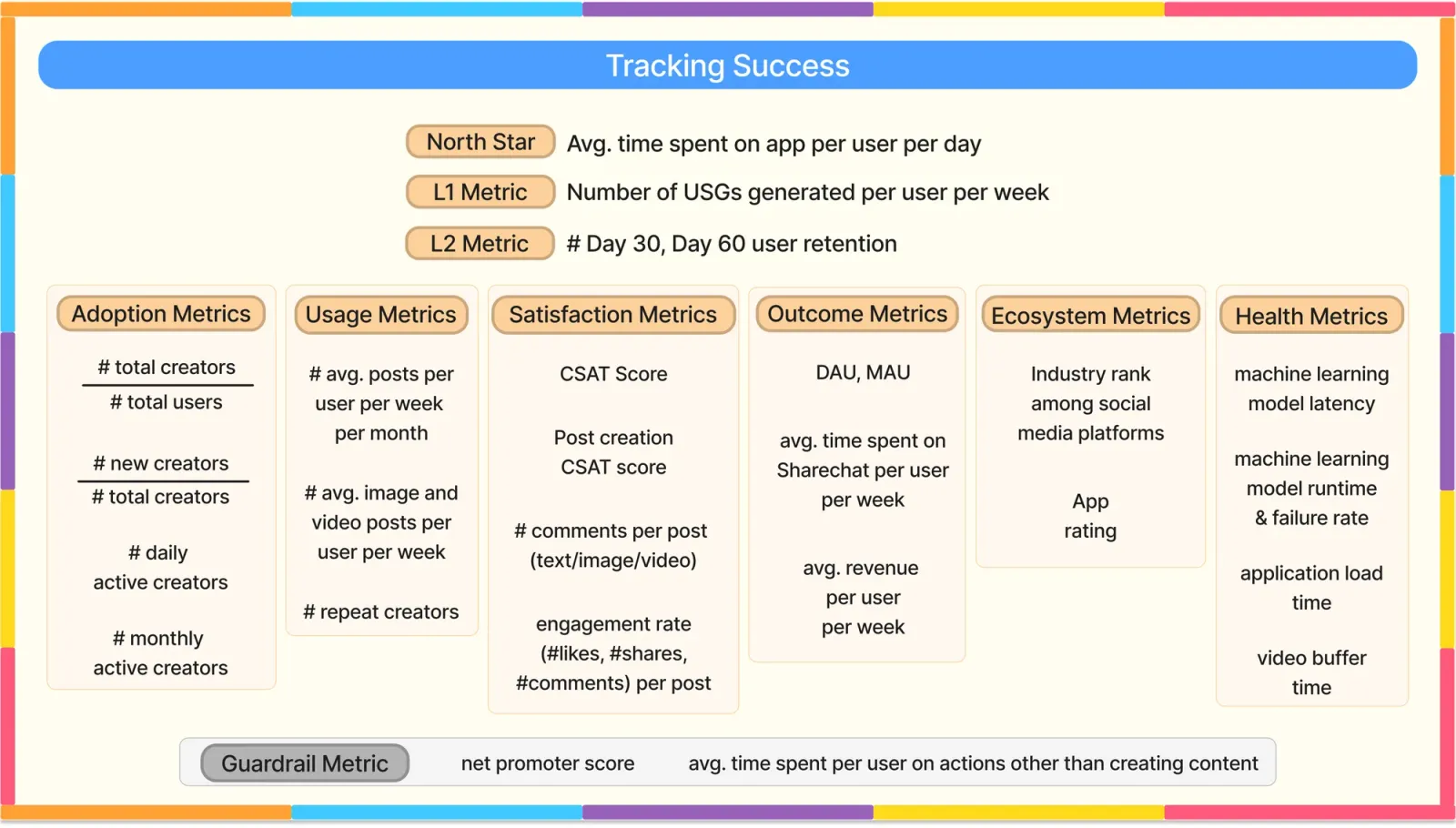
Slide 9, Tracking success. North Star: average time spent on the app per user per day. L1 metric: number of user-generated content generated per user per week. L2 metric: Day 30 and Day 60 user retention. Adoption metrics: total creators divided by total users, new creators divided by total creators, daily active creators, monthly active creators. Usage metrics: average posts per user per week or month, average image and video posts per user per week, repeat creators. Satisfaction metrics: CSAT score, post-creation CSAT score, comments per post for text, image and video, and engagement rate of likes, shares and comments per post. Outcome metrics: DAU and MAU, average time spent on ShareChat per user per week, average revenue per user per week. Ecosystem metrics: industry rank among social media platforms and app rating. Health metrics: machine learning model latency, model runtime and failure rate, application load time, video buffer time. Guardrail metrics: net promoter score, and average time spent per user on actions other than creating content.
Slide 9A proposed measurement framework: Kreator was not shipped, so none of these has been measured. The deck writes “USGs”; it means UGCs, user-generated content.Open in deck (opens in a new tab)