Financial stability
Rejuvenate an ageing customer base. First cards are sticky, so acquire users early.
Product case study
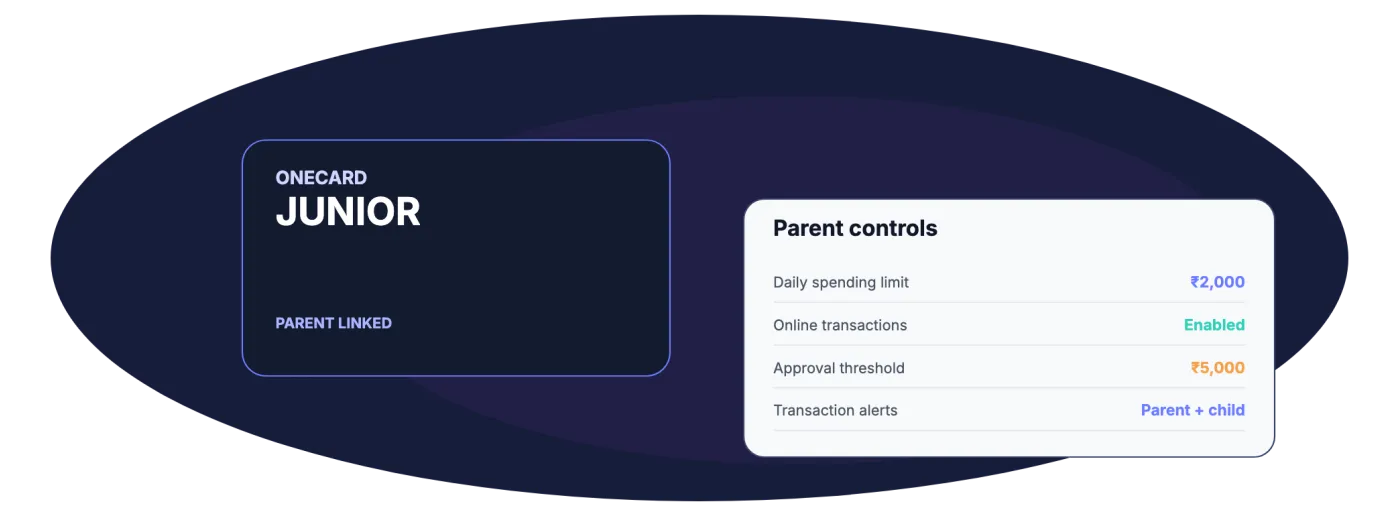
A first card for 8 to 18 year olds, run by parents.
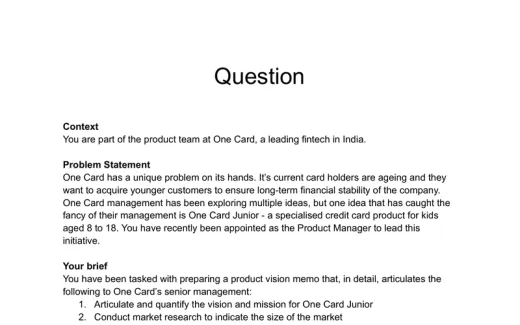
My own exploration of OneCard Junior: financial independence with parental guardrails for kids aged 8 to 18. Market size, four personas, an MVP ranked with MoSCoW and RIFE, and a feature pitch with three specs.
A credit product with a guardianThe memo calls OneCard Junior a specialised credit card product for kids aged 8 to 18, and notes that only adults can hold a credit card in India, though a child can be added as an authorised user. The specs put a parent in control: limits, alerts and approval of larger payments. The Limits spec says its focus is debit cards, and some memo features, such as top-up and a balance, read like a prepaid card. They are shown as written.
Rejuvenate an ageing customer base. First cards are sticky, so acquire users early.
Build trust from a young age, and use the 8 to 18 network effect for referrals.
Track spending behaviour over time to shape future products.
Teach responsible money habits to the next generation.
Step 1
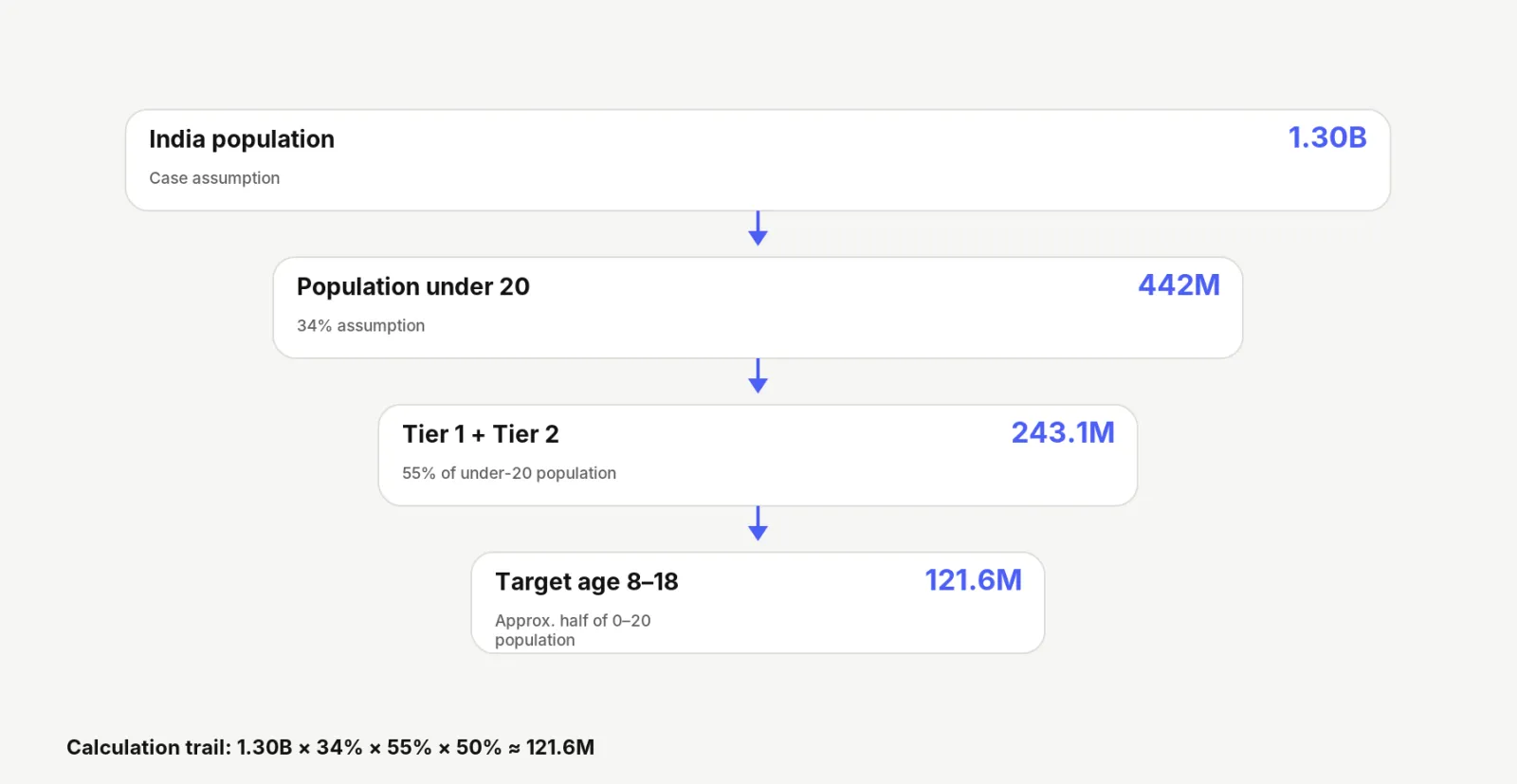
| Population of India | 1,300,000,000 |
| Under 20 years of age | 34% |
| People under 20 | 442,000,000 |
The share under 20 is assumed to be the same in every tier of city.
Carries to step 2442,000,000
Step 2
| City type | Share | People | Scope |
|---|---|---|---|
| Tier 1 cities | 20% | 88,400,000 | In scope |
| Tier 2 cities | 35% | 154,700,000 | In scope |
| Tier 3 cities | 20% | 88,400,000 | Out of scope |
| Tier 4 cities | 25% | 110,500,000 | Out of scope |
The sheet drops Tier 3 and 4 for access to smartphones, bank accounts and literacy. Tier 1 plus Tier 2 are 55% of the people under 20.
Scope 1, carries to step 3243,100,000
Step 3
| Age group | Share | People | In the target |
|---|---|---|---|
| 0-4 | 20% | 48,620,000 | Not counted |
| 5-8 | 20% | 48,620,000 | Not counted |
| 8-12 | 20% | 48,620,000 | Counted |
| 12-16 | 20% | 48,620,000 | Counted |
| 16-20 | 20% | 48,620,000 | Half counted |
Five equal buckets, so 2.5 of them is the target.
Scope 2, the target121,550,000
Market Size GuesstimateRecomputed here from the sheet's own inputs (28 rows). The sheet labels its columns 0 to 25 years and its age buckets overlap (5-8 and 8-12); both are shown as written. The sheet is in the original artifacts below.
The ideaA parent-linked card for 8 to 18 year olds: the child gets financial independence, the parent keeps the guardrails, and OneCard reaches a customer group it does not serve today.
01
Listed credit cards need age 18, a loan or an income. The sheet's assumptions put children aged 8 to 18 in Tier 1 and 2 cities at 121.5M.
The market02
Two children and two parents. The child wants independence while learning money; the parent wants control without constant supervision.
The personas03
Features sorted by MoSCoW, then the Must-haves scored on reach, impact, frequency and effort, so the first release stays small.
MoSCoW and RIFE04
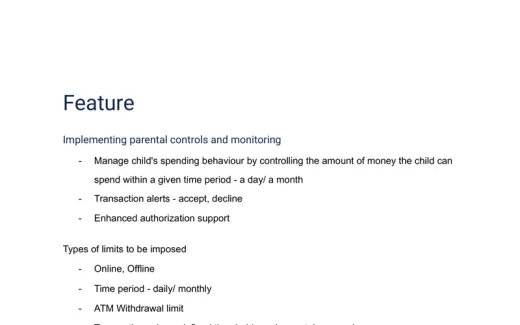
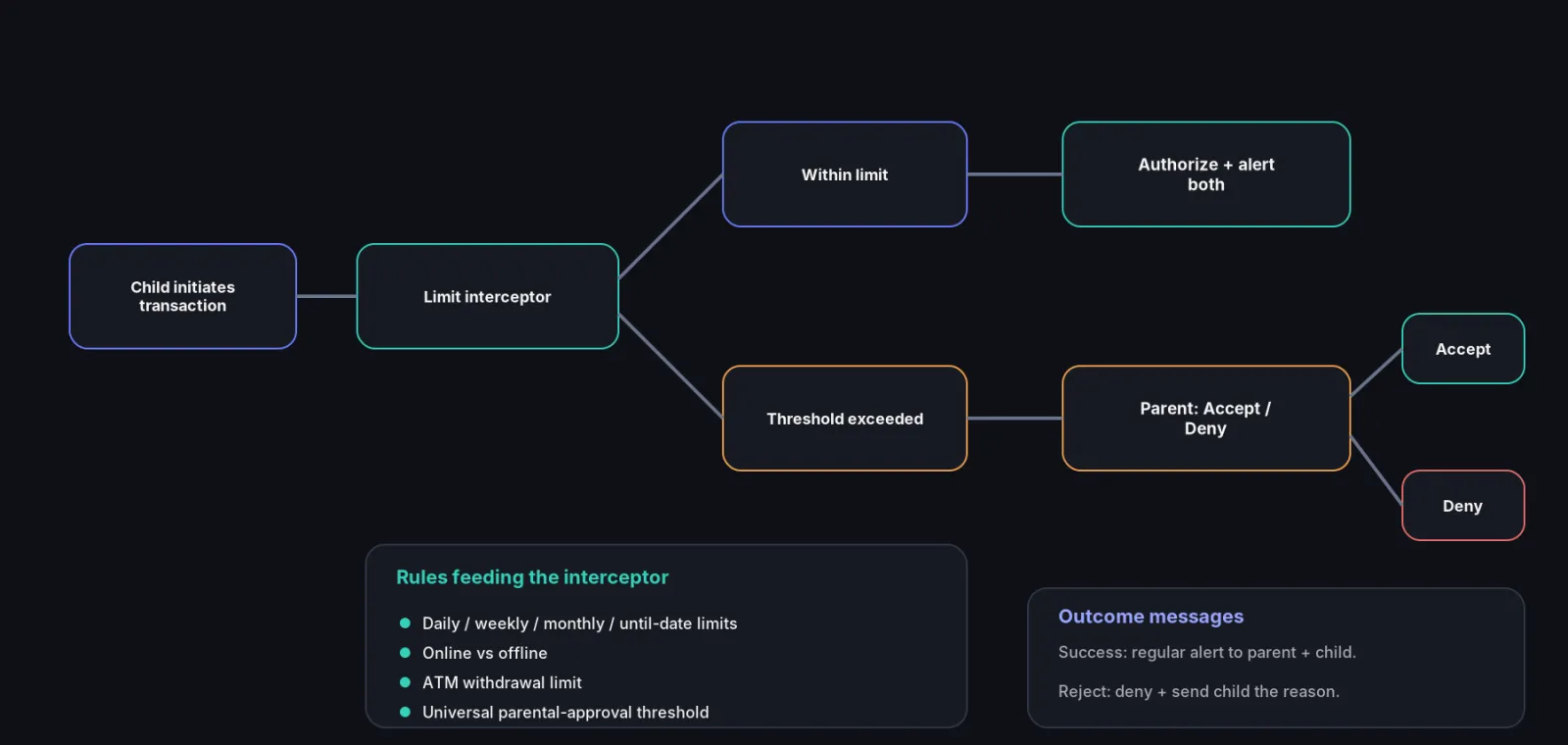
Spending limits by day or month, online or offline, with an ATM cap, all checked before a payment is authorised.
The three specs05
Above a set amount a payment waits for a parent to accept or decline, and the child sees the reason.
The wireframes06
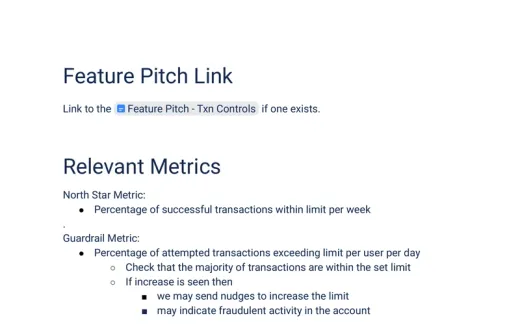
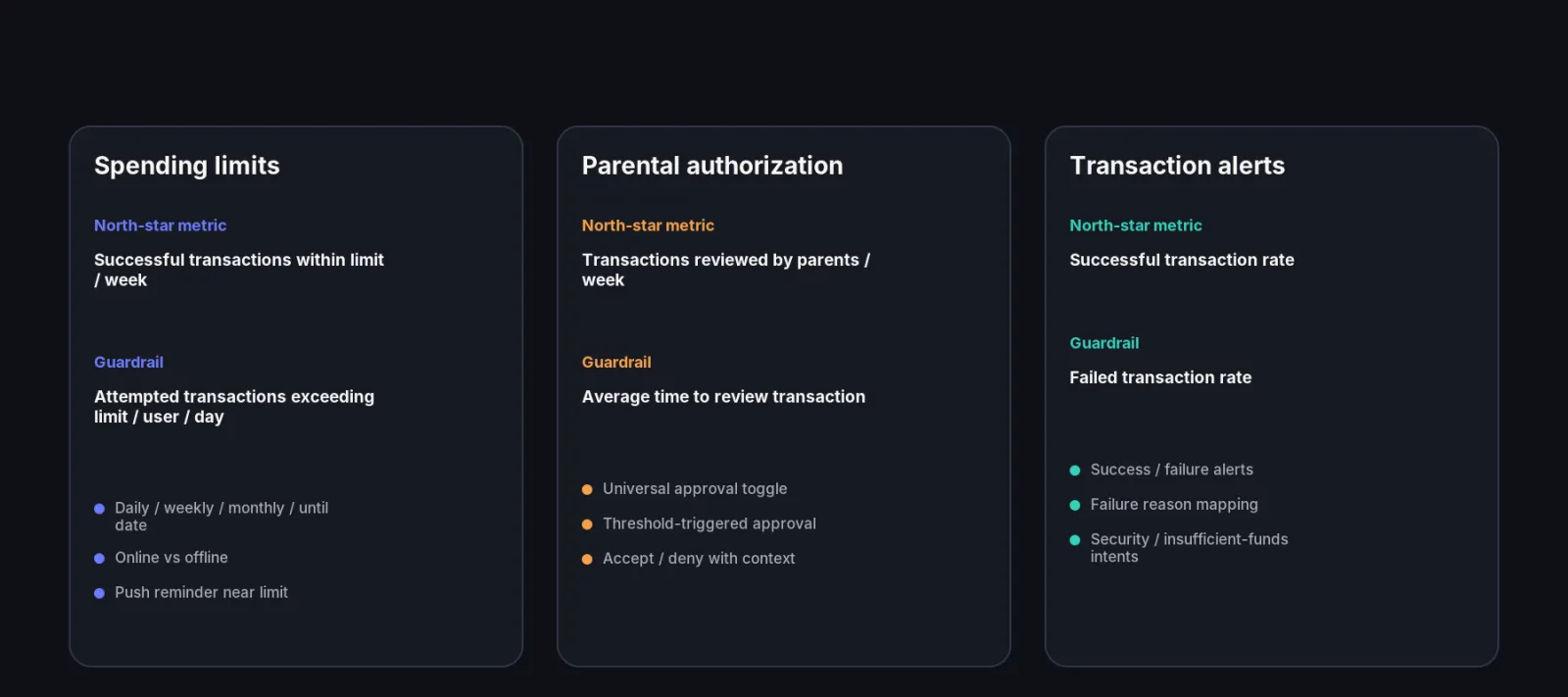
Each control has a north star and a guardrail. Acquisition is the goal, and these are proposed metrics, not results.
The metricsThree screens, from the kids list to the tap limit.
1 / 3
Step 01
The parent's home screen lists each child. A click on a child opens that child's limits.
Step 02
Remaining limit, days since the last change and the share used, then the duration and a slider for each kind of payment.
Step 03
A scroll reaches the tap limit: a Tap toggle and a slider, set to Rs. 5,000 in the wireframe.
Two screens: the child's limits, then the alerts.
1 / 2
Step 01
The same limits screen, with an alert icon beside the child's name. A click on the icon opens the alerts screen.
Step 02
An Enabled toggle and a success summary over a chosen period, with failures broken down by reason. The percentages are sample values.
Seven screens, from the kids list to the child's message.
1 / 7
Step 01
The same kids list as in the limits wireframe: Rahul and Reena, each with an Active toggle, Max Limit and the share of limit left.
Step 02
One global toggle and slider, and one slider per child. Rahul's is on and Reena's is off in the wireframe.
Step 03
When a child tries a large payment, a banner tells the parent. The wireframe spells it as written: Rs. 1,00,000 at Udemy.
Step 04
The banner opens a prompt over the dimmed app, with Accept, Reject and a way to call the child.
Step 05
Rejecting opens a menu of reasons. The wireframe lists four presets and a custom option.
Step 06
Choosing Custom opens a text box with a 300 character limit.
Step 07
The child's phone shows a banner with the parent's reason. The wireframe's own wording is kept in the image.
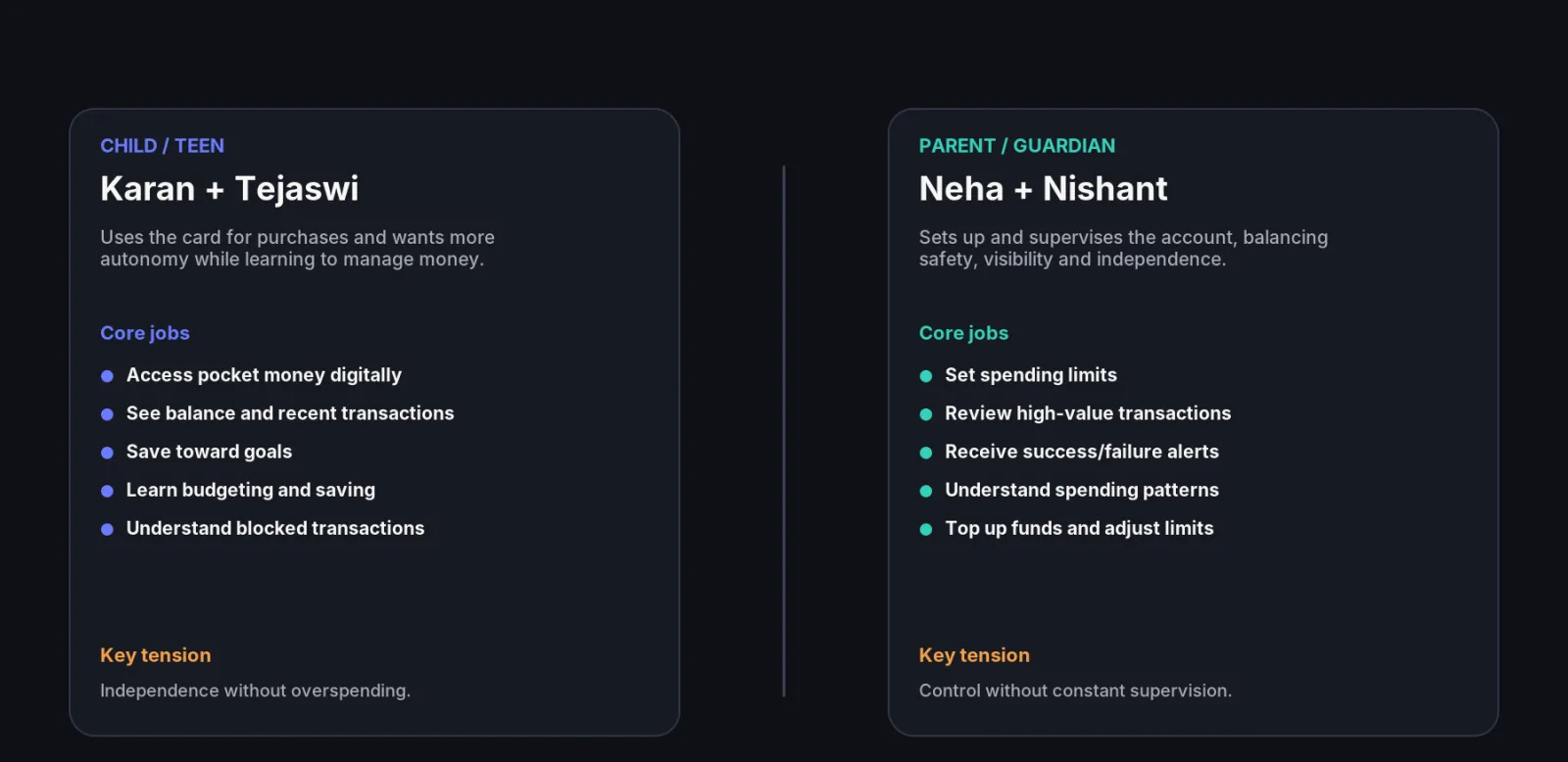
Kid, 12
Suburban Mumbai
Kid, 16
Rural Uttar Pradesh
Parent, 40
Delhi
Parent, 45
Bhiwadi
Debit cards for kids
IDFC First Bank
Set up in the FamPay app. One-time Rs 99 (Rs 299 for FamCard ME). Zero balance support.
Yes Bank, Visa
Virtual card free, physical Rs 399 (Rs 199 offer). Rewards, cashback and in-app lessons.
RBL Bank
Virtual card free after KYC, physical Rs 99. 2% back on UPI top-ups, parent-set tasks.
RBL Bank
Virtual card free, physical Rs 199. Parents send pocket money and track spends.
Credit cards for students
Students with an SBI loan
Needs an SBI fixed deposit. Zero annual fee, fuel surcharge waiver.
Students studying abroad
18 and over, KYC and foreign enrolment. Funds in several currencies.
First-time card users
Needs stable income and good credit history. Cashback, travel rewards.
Students who travel
18 and over, KYC and enrolment proof. Global ATM cash, travel discounts.
GapTwo of the four credit cards state 18 and over; the other two need an SBI loan or a stable income. The four kid cards are all debit, each run through its own app.
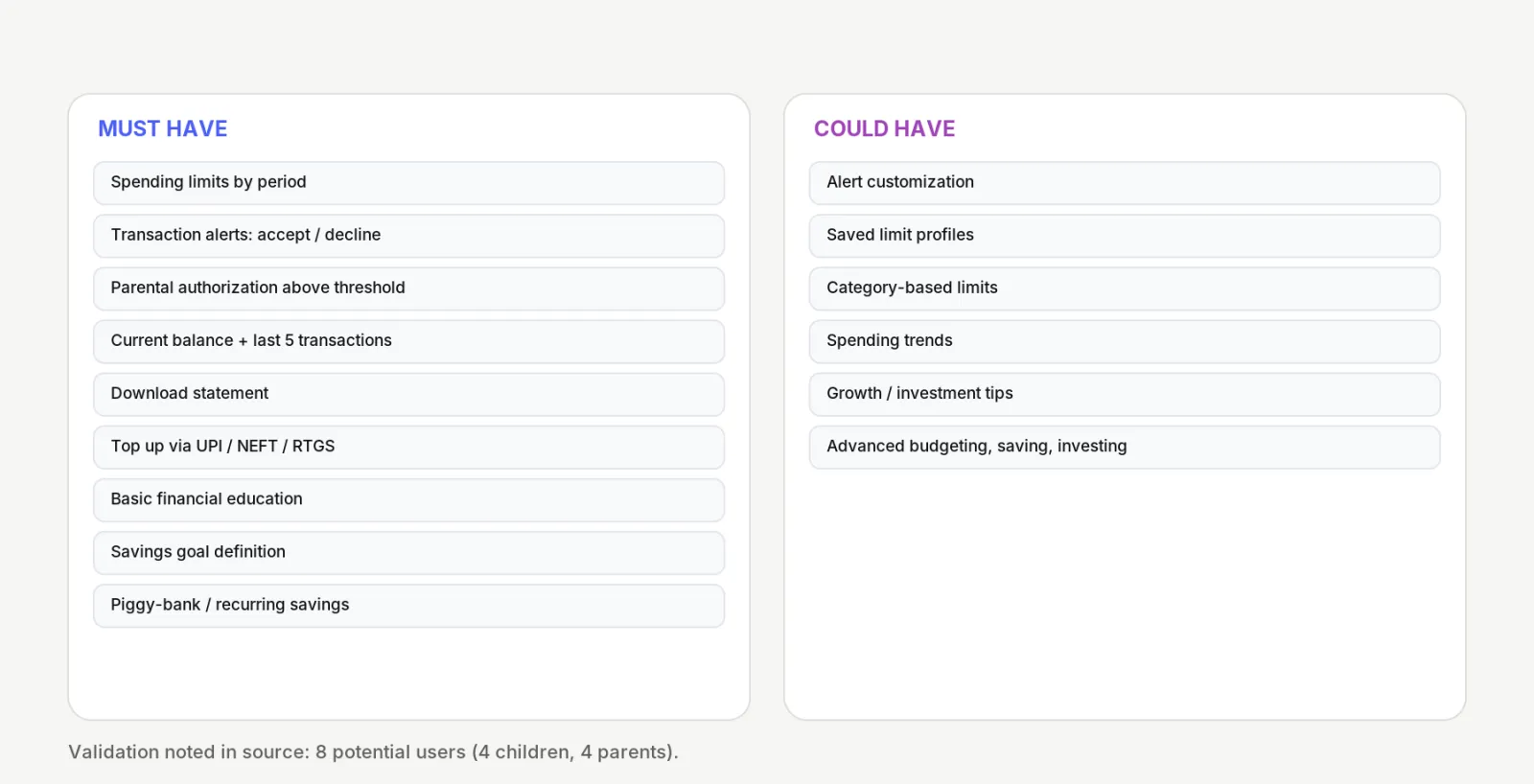
Each tag is a letter as well as a style: M must, S should, C could. Cross-checked in phone calls with 8 potential users, 4 children and 4 parents.
| Group | Feature | Reach | Impact | Frequency | Effort |
|---|---|---|---|---|---|
| Parental controls | Spend limits by day or month | Very High, over 75% | Very High | Mid, monthly | M, under 1 month |
| Parental controls | Alerts: accept, decline | Very High, over 75% | Very High | Very High, daily | M, under 1 month |
| Parental controls | Approval above a threshold | Very High, over 75% | Very High | High, weekly | L, under 2 months |
| Insights | Balance and last 5 transactions | Very High, over 75% | Very High | Mid, monthly | M, under 1 month |
| Insights | Download statement | Very High, over 75% | Very High | Mid, monthly | M, under 1 month |
| Top up | UPI, NEFT, RTGS | Very High, over 75% | Very High | Mid, monthly | M, under 1 month |
| Financial education | Basic interactive lessons | Mid, under 50% | High | Very High, daily | L, under 2 months |
| Start investing early | Goal definition | Mid, under 50% | Mid | Very High, daily | L, under 2 months |
| Start investing early | Piggy bank | Mid, under 50% | Mid | Very High, daily | L, under 2 months |
| Rewards | Points at partners | Mid, under 50% | High | Low, few times a year | L, under 2 months |
| Secure payments | Two-factor, encryption, fraud | Very High, over 75% | Very High | Mid, monthly | M, under 1 month |
| Customer support | Easy-to-find touchpoint | Very High, over 75% | Very High | Mid, monthly | M, under 1 month |
| Customer support | Short waits, trained executives | Very High, over 75% | Very High | Mid, monthly | L, under 2 months |
The memo rates by label, so no score or total is computed here. Thirteen rows are scored; the second secure-payments Must (alerts, category blocking, limits) shares its rating with alerts and limits.
Parents set how much the child can spend.
Parent and child hear about every payment.
Large payments wait for a parent's yes.
Two hypotheses to validate
Parents will actively monitor and manage their child's spending, find the controls easy to set up, and see a real benefit.
Children understand why limits exist, and hitting a limit does not turn into a bad experience.
What parents do today
Reviewing statements, cash and receipts: slow, and little visibility or control.
Parents load funds and watch: rigid limits, high fees, transactions only.
Rules agreed by talking: hard to enforce, easy to misremember.
Vendor pricing researchLimits are lifetime free. Alerts include 1,000 free messages a month (500 unique transactions), then a small annual fee, which also curbs over-messaging. Approval is free at first, with an annual charge considered later.
What it can do
01
02
03
04
05
06
The spec itself: open the PDF (opens in a new tab).
What it can do
01
02
03
04
05
The spec itself: open the PDF (opens in a new tab).
What it can do
01
02
03
04
05
The spec itself: open the PDF (opens in a new tab).
Percentage of successful transactions within limit, per week
Percentage of attempted transactions exceeding the limit, per user per day
A rise can mean the limit needs a nudge up, or fraud.
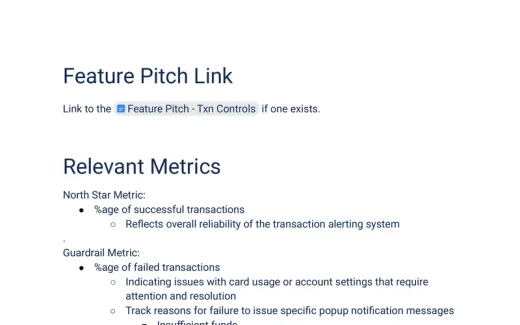
Percentage of successful transactions, a measure of how reliable alerting is
Percentage of failed transactions, with the failure reason tracked
Reasons such as insufficient funds or security shape the message.
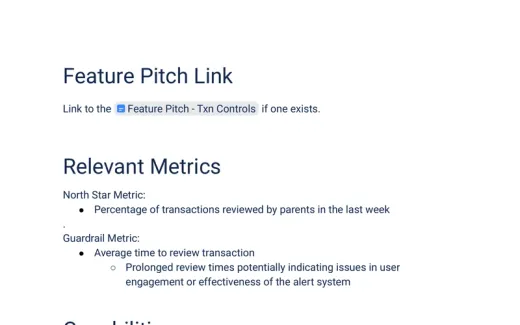
Percentage of transactions reviewed by parents in the last week
Average time to review a transaction
Long reviews point to weak engagement or a weak alert.
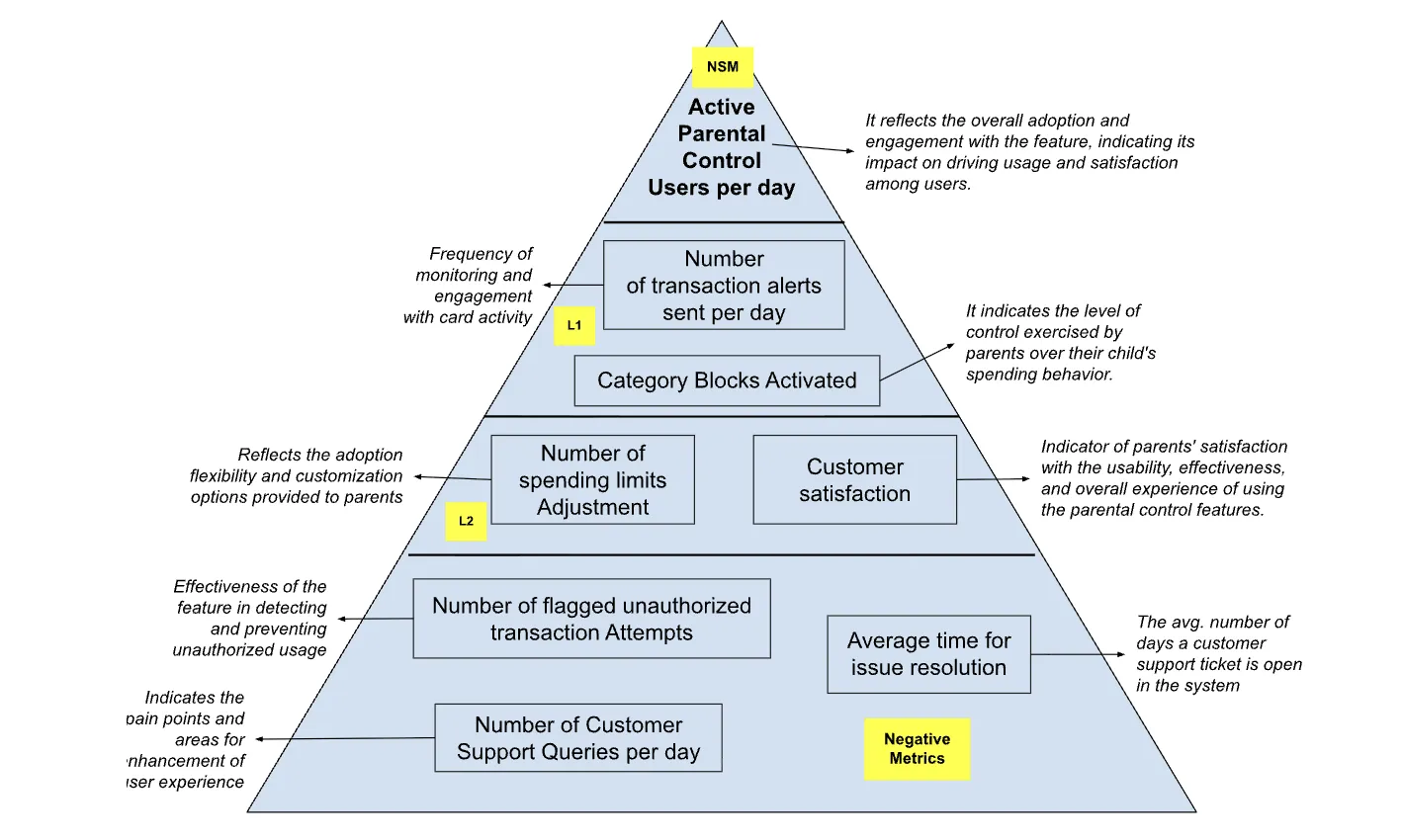
Primary goalAcquisition: issue new cards to the 8 to 18 age group. The controls are meant to give parents peace of mind and make children mindful of what they spend. These are proposed metrics, not results.
Launch PR note, as submitted
We're thrilled to announce the launch of OneCard Junior, a revolutionary credit card product designed specifically for kids aged 8 to 18. OneCard Junior empowers young individuals to learn responsible financial habits in a safe and controlled environment. With innovative parental control features, customizable spending limits, and engaging financial education modules, OneCard Junior equips children with essential money management skills while providing peace of mind to parents. Join us in shaping the future of finance and nurturing the next generation of savvy spenders and savers with OneCard Junior!
Every source document, unedited. Each is also linked from the section it supports.
Download the original documents (zip)PDF · May 2024
PDF · May 2024
PDF · Jun 2024
PDF · May 2024
PDF · May 2024
Excel · May 2024