Given
Why it is hard today
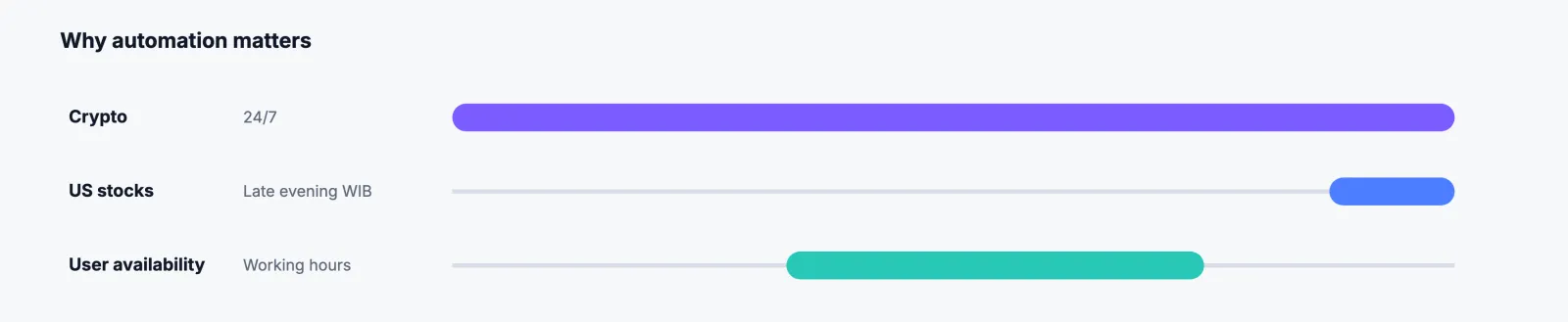
- The crypto market is open 24/7, and global (US) stocks start at 9 PM local time
- Analysing, trading and monitoring positions is difficult for the average user
Product case study
Trading bots for markets open while users sleep.
A case brief asked how Pluang, a multi-asset investing app in Indonesia, could get users to transact more with trading bots. I ranked three bot ideas with DHM, specified the lead one with limits, wireframes and metrics, and planned a five-phase roadmap.
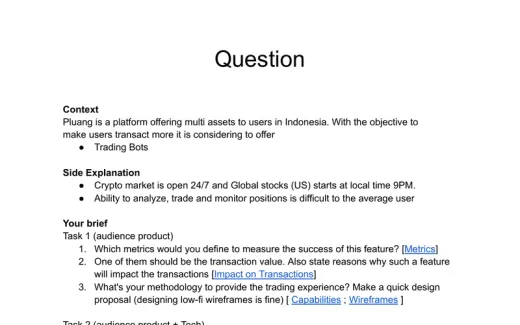
The question, as givenPluang is a platform offering multi assets to users in Indonesia. With the objective to make users transact more it is considering to offer trading bots.
Given
Task 1 · product
Task 2 · product and tech
Scope I setTransact more is read as the number of transactions, not their value. The target market stays Pluang's current user base, and the pain points found are to be solved with trading bots.
More transactions can mean more revenue through the fees attached to each one.
Trade across markets, time zones and asset classes with ease, and without panic buying or selling.
Users monitor investments without manual oversight, which lifts engagement and, in the long run, retention.
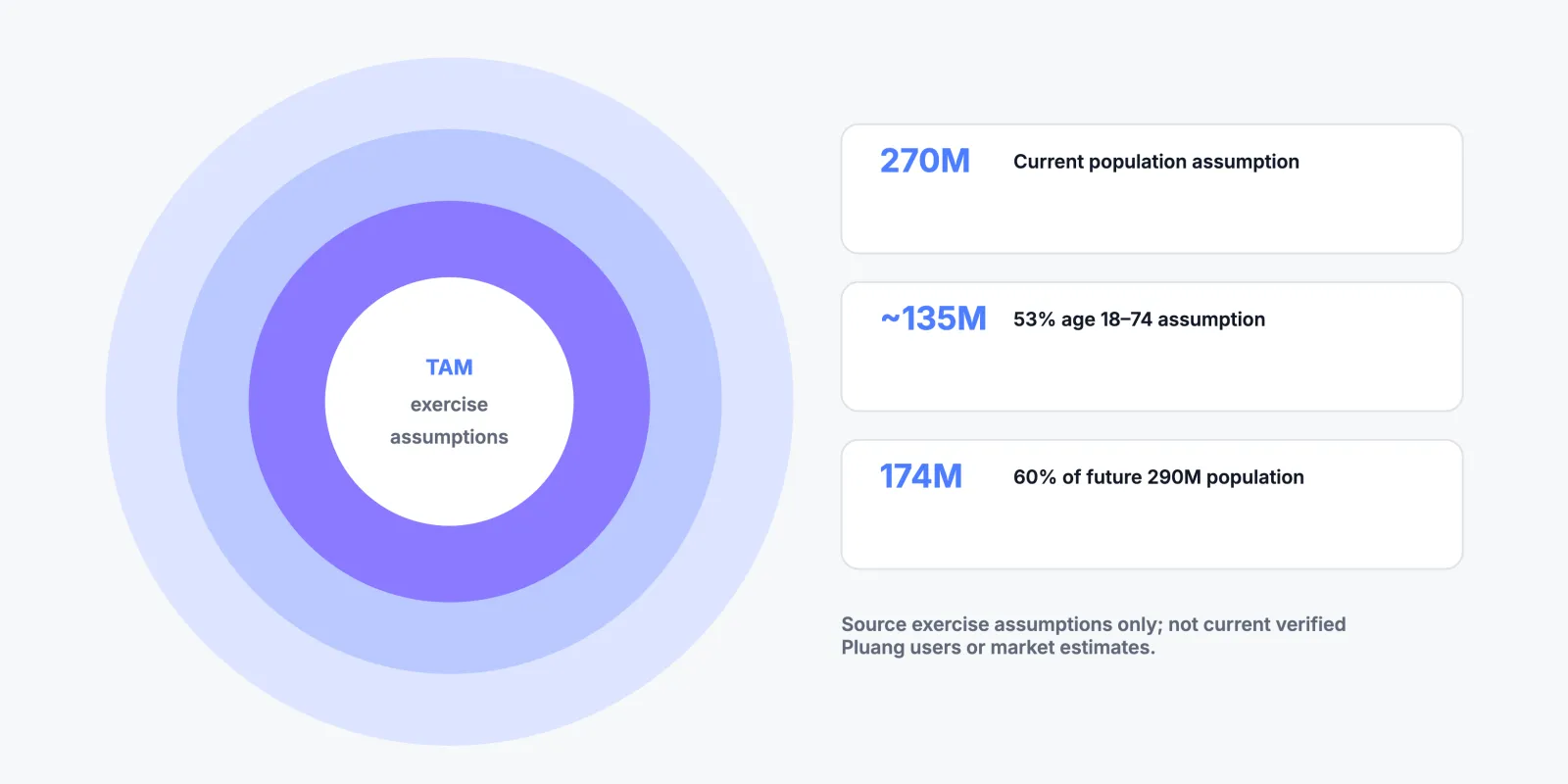
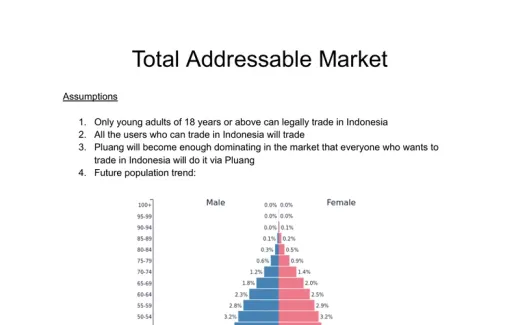
An upper boundThe note assumes that only adults of 18 and over can legally trade in Indonesia, that everyone who can trade will, and that all of them trade through Pluang. It also takes life expectancy as about 74 years, which sets the 18 to 74 range.
Step 1
| Population of Indonesia | 270,000,000 |
| Aged 18 to 74, as the note cites | 53% |
| Market potential the note states, about | 135,000,000 |
The note rounds to about 135 million, which is half of 270 million; 53% works out to 143,100,000. Shown as written.
Today, as statedabout 135,000,000
Step 2
| Projected population | 290,000,000 |
| Share assumed to trade, around | 60% |
| Future market | 174,000,000 |
The memo's TAM174,000,000
The ideaGive users trading bots that run their own strategies around the clock, inside limits they set, so they can transact across markets without watching them.
01
A bot runs a strategy the user defines, with entry, exit and sizing rules, so trades follow a plan instead of emotion.
The bot spec02
Crypto trades 24/7 and US stocks open at 9 PM local time, so a bot covers the hours when people work or sleep.
The problem03
Trading bots, a portfolio manager and a market insights bot were rated on DHM; trading bots rate High on all three.
The DHM pass04
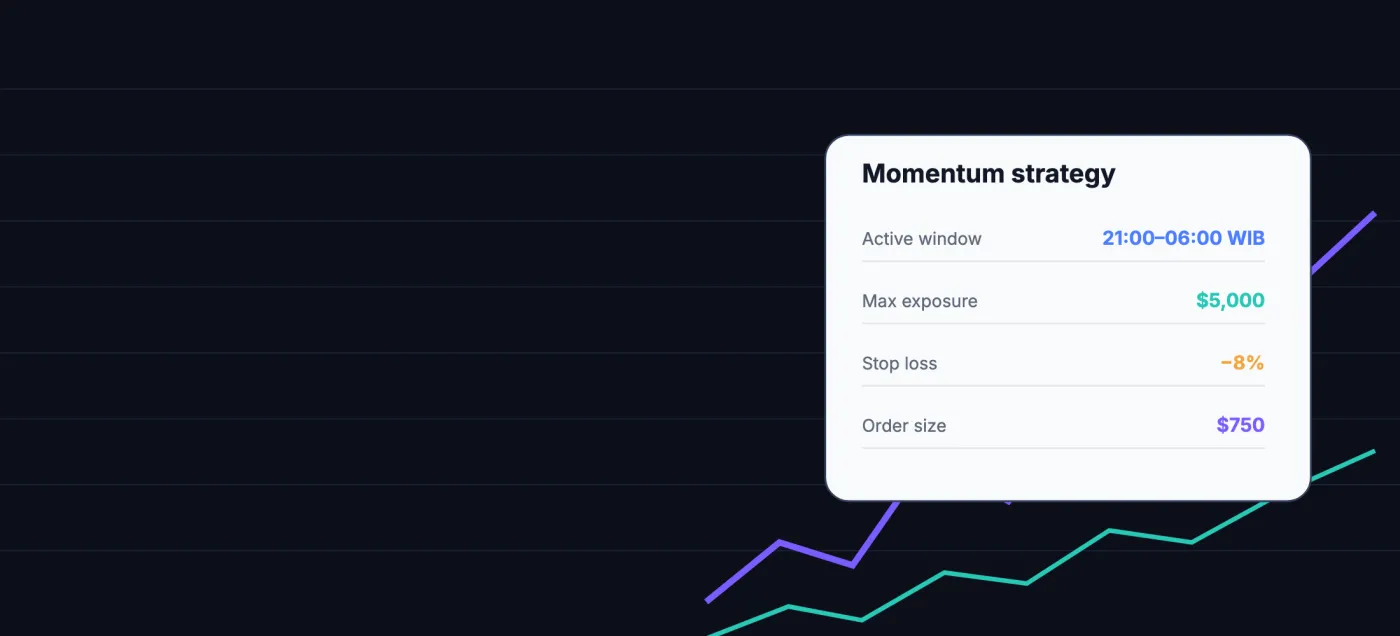
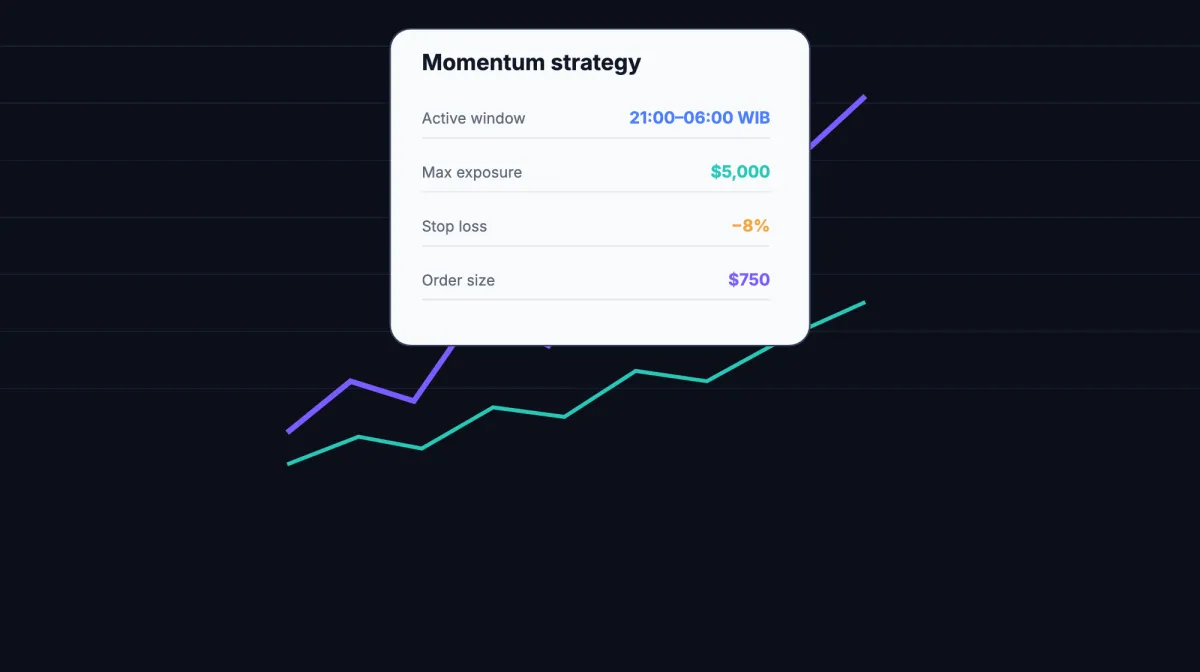
A time window, maximum exposure, stop-loss, order size and maximum loss keep a bot inside what the user can afford.
The limits05
Users test a strategy on past data and refine it before it is deployed, so a bad idea fails on paper.
The capabilities06
Transaction value is a Level 1 metric, as the brief asks. Engagement is the goal and risk-adjusted return a guardrail.
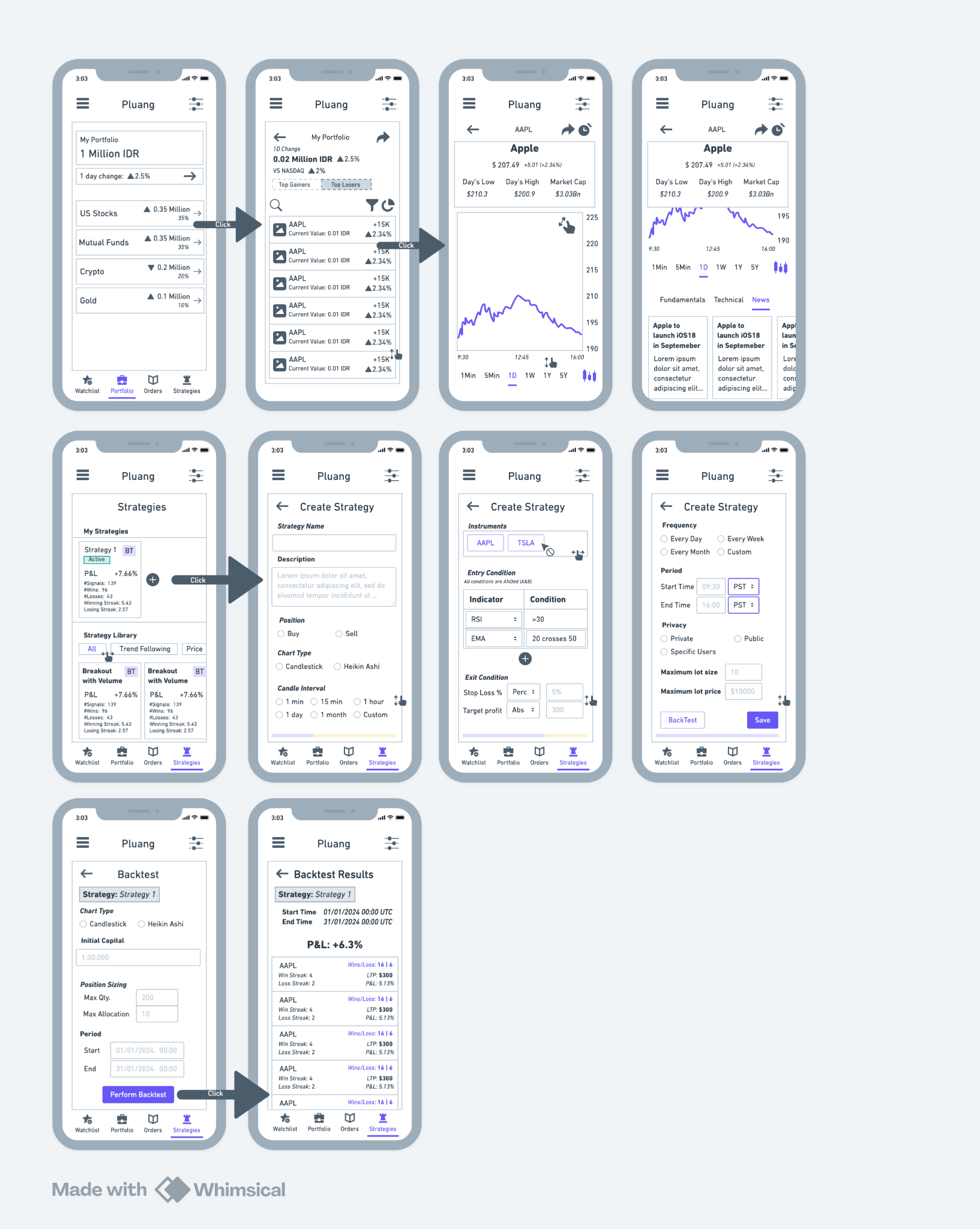
The metricsFour screens: the portfolio, one asset class, an asset's chart, then its news.
1 / 4
Step 01
The portfolio opens on its total and one row per asset class. A click on US Stocks opens that class. The amounts are placeholders.
Step 02
The class's one-day change against NASDAQ, a Top Gainers and Top Losers switch, then each holding. A click on a holding opens it.
Step 03
The asset's price, the day's low and high, market cap and a chart that can be dragged, with ranges from one minute to five years.
Step 04
A scroll brings up three tabs under the chart: Fundamentals, Technical and News. The news cards hold filler text, typo included.
Four screens: the strategy list, then the create form in three scrolls.
1 / 4
Step 01
The user's own strategies with their record, a plus to create one, and a library to start from. Every figure on the cards is a placeholder.
Step 02
A click on plus opens Create Strategy. First the name and description, buy or sell, the chart type and the candle interval.
Step 03
A scroll reaches the instruments, entry conditions that are ANDed, and the exit: a stop loss and a target profit, each as a percentage or an absolute.
Step 04
A further scroll sets how often and when the bot runs, who can see the strategy, and its lot and capital limits, then BackTest or Save.
Two screens: the backtest form, then its results.
1 / 2
Step 01
BackTest opens this form: the chart type, starting capital, position sizing and the period to test. Perform Backtest runs it.
Step 02
The result for the period, then a row per instrument with wins and losses, streaks, last traded price and P&L. All values are placeholders.
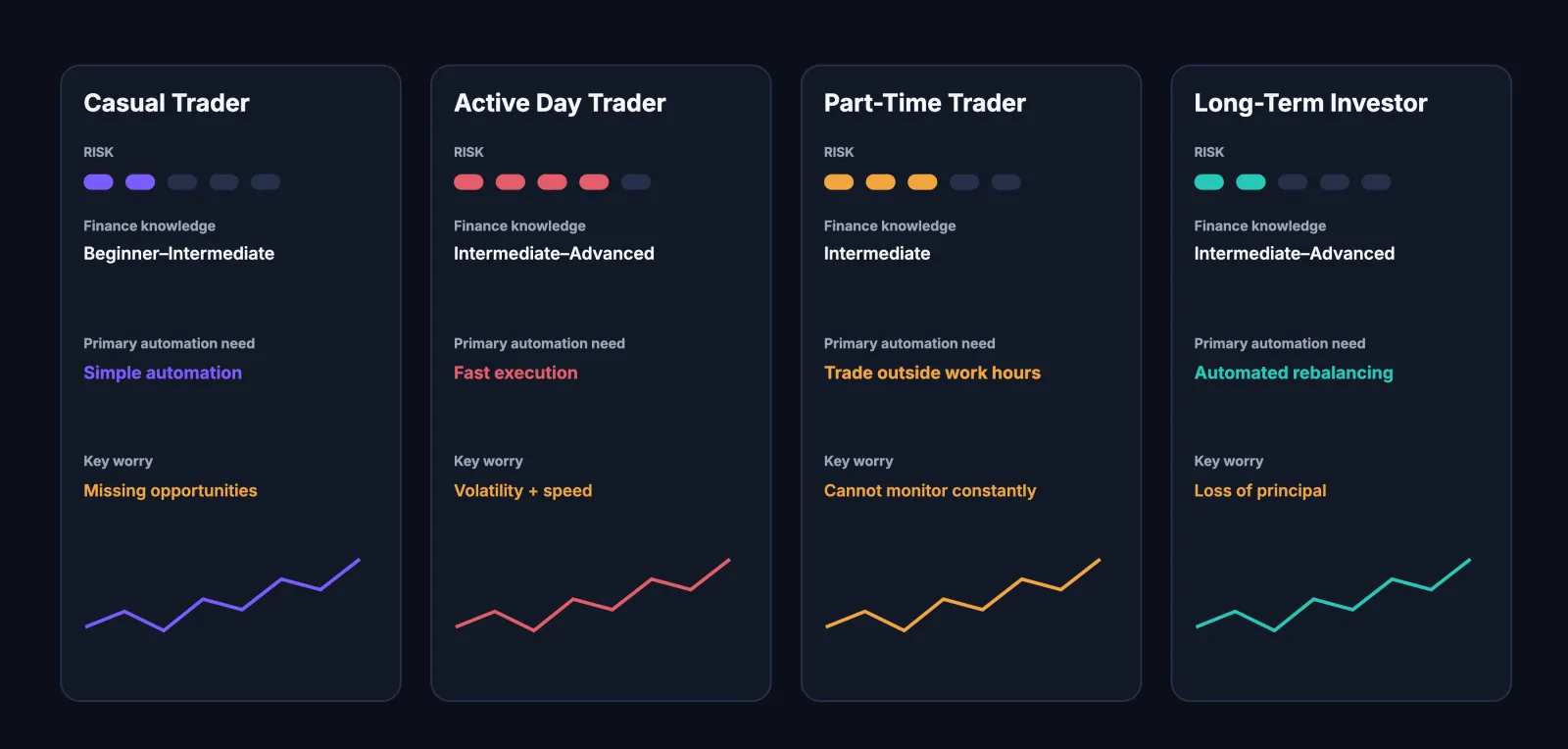
Low risk
Beginner to intermediate
High risk
Intermediate to advanced
Moderate risk
Intermediate
Low risk
Intermediate to advanced
The personas come from interviews with 10 individuals; the brief's two pain points, round-the-clock markets and trading outside local hours, set the scope of the problems kept.
| Criterion | Pluang | Bareksa | Ajaib | Stockbit |
|---|---|---|---|---|
| Core services | Gold, mutual funds, US stocks, cryptocurrency | Mutual funds, ETFs | Stocks | Stocks, community insights |
| Platform | Mobile-first app on Android and iOS, web platform | Mobile-first app on Android and iOS, web platform | Mobile-first app on Android and iOS | Mobile-first app on Android and iOS, web platform |
| Investment options | Diverse global assets | Mutual funds | Stocks | Stocks, cryptocurrency |
| User base | Broad demographic, tech-savvy investors | Established investor base | Young professionals | Retail investors |
| Education | Guides, market insights, news analysis, blogs | Investment articles | Trading tutorials | Community discussions |
| Positioning | A growing multi-asset fintech in Indonesia | Leading mutual fund platform | Emerging stock trading app | Stock trading community |
| Support | Email support, FAQs | 24/7 customer service | Email support, live chat | Email support |
| Growth strategy | Enhancing mobile app features, expanding investment options | Partnerships with banks | Market expansion | Community engagement focus |
The memo's own comparison of Pluang with three Indonesian platforms, as written in June 2024. It also lists each one's revenue streams; those are in the memo.
| Trend | Relevance to the brief | Companies named |
|---|---|---|
| Automated trading and AI-powered bots | Ideal for the always-open crypto market and late US stock market hours | TokoCrypto, Indodax |
| Personalized investment advice | Guides users through complex trading decisions | Betterment, Wealthfront, Nutmeg |
| Robo advisors | Effective management for users unable to monitor their positions constantly | Schwab Intelligent Portfolios, SoFi Automated Investing, Acorns |
| Integration of DeFi | Additional 24/7 trading opportunities with more control | Compound, Aave, Uniswap |
| Real-time analytics and data visualization | Simplifies market understanding for timely decisions | TradingView, Stockbit, Investing.com |
| Mobile trading platforms | Lets users trade anytime, anywhere | Pluang, Ajaib, Bibit, Robinhood |
| Social trading and copy trading | Leverages expertise, helping average users | eToro, ZuluTrade, Covesting |
| Enhanced security measures | Builds user confidence in trading, crucial for crypto markets | Coinbase, Binance, Gemini |
| Gamification of trading | Engages users, encouraging frequent transactions | Freetrade, BUX, Invstr |
Borrowed from adjacent industries
E-commerce and streaming
Use AI to recommend investment products and strategies to users.
Logistics and manufacturing
Offer similar automations so users spend less manual effort managing portfolios.
Social media
Read investment patterns to find what interests users, and automate their repetitive tasks.
Telecom
Partner with chart and news providers to improve the experience.
All four personas
Bots that execute trades on predefined strategies 24/7, without constant monitoring.
Casual, part-time, long-term
Bot trades that rebalance a portfolio periodically to optimize long-term returns, across market times.
All four personas
An AI question-and-answer chatbot that analyses news: intents during live trading, insights to a mailbox when offline.
Assumed for all threePluang has, or can acquire, the technical capability to build sophisticated trading bot algorithms; building and deploying bots complies with financial regulation in Indonesia; and users get the education and support to use them.
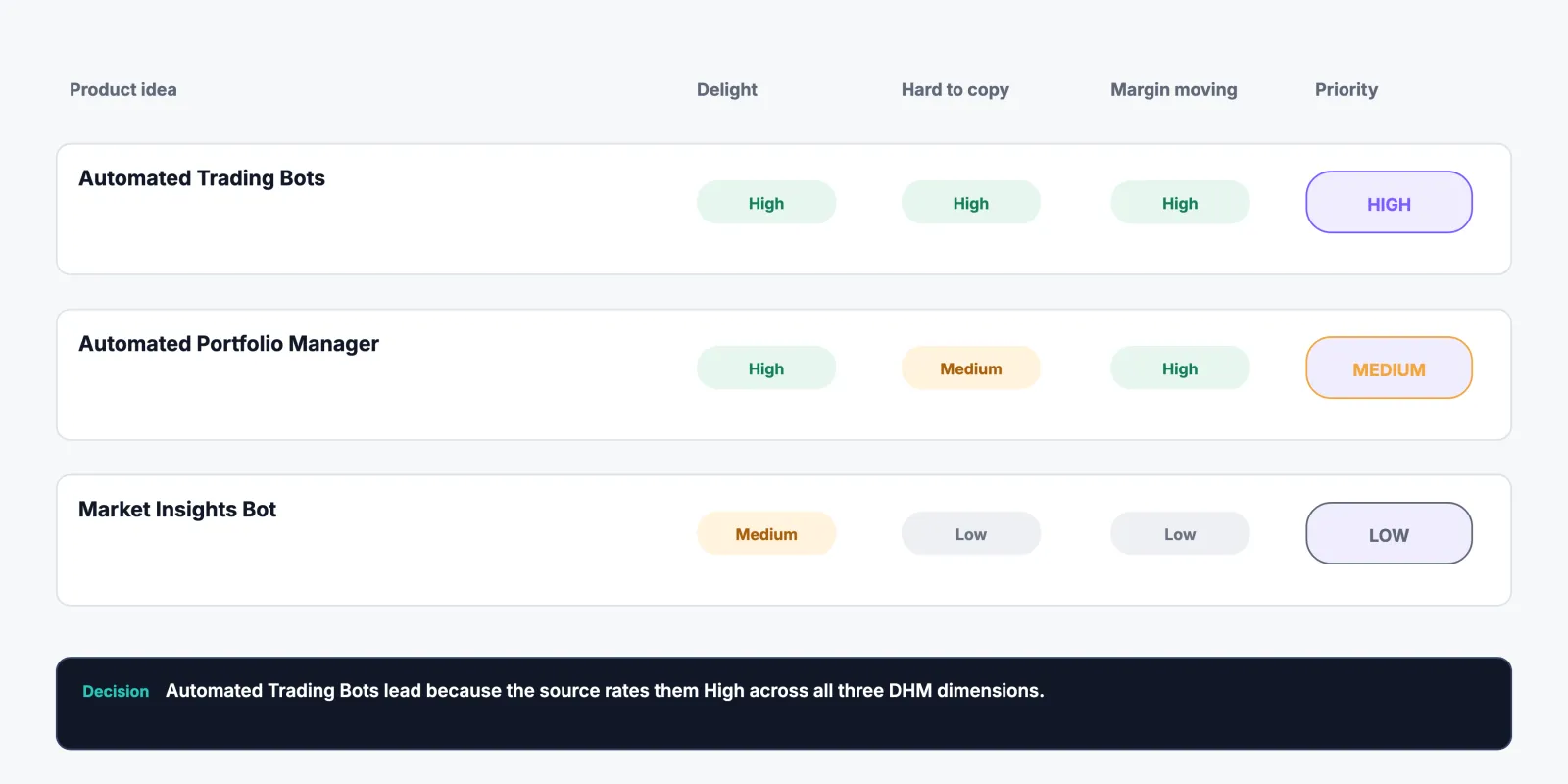
D
How much the solution improves user experience and satisfaction.
H
How difficult it would be for competitors to replicate the solution.
M
The potential effect on revenue generation or cost savings.
How priority followsHigh priority scores high on all three; medium is a mix of high and medium; low scores lower on one or more and has less immediate impact or differentiation. The roadmap is then written for the first idea only.
01
Receives and processes live market data, and analyses price movements, trends and indicators across assets.
02
Users define strategies on different indicators and set entry, exit, position sizing and risk rules.
03
Sell orders trigger at set thresholds, as absolute levels or a percentage of the buy price or a custom price.
04
Customizable reports on risk exposures, mitigation strategies and performance attribution.
05
Tools to test a strategy on past data and refine it before it is deployed.
Why it would raise the number of transactions
Trades execute in milliseconds, so price movements are acted on promptly.
Bots run through non-trading hours and across global markets, catching what a person would miss.
Trades follow predefined rules, which removes emotional decision-making.
Many trades at once, across different assets and markets.
Complex strategies carried out with precision and consistency.
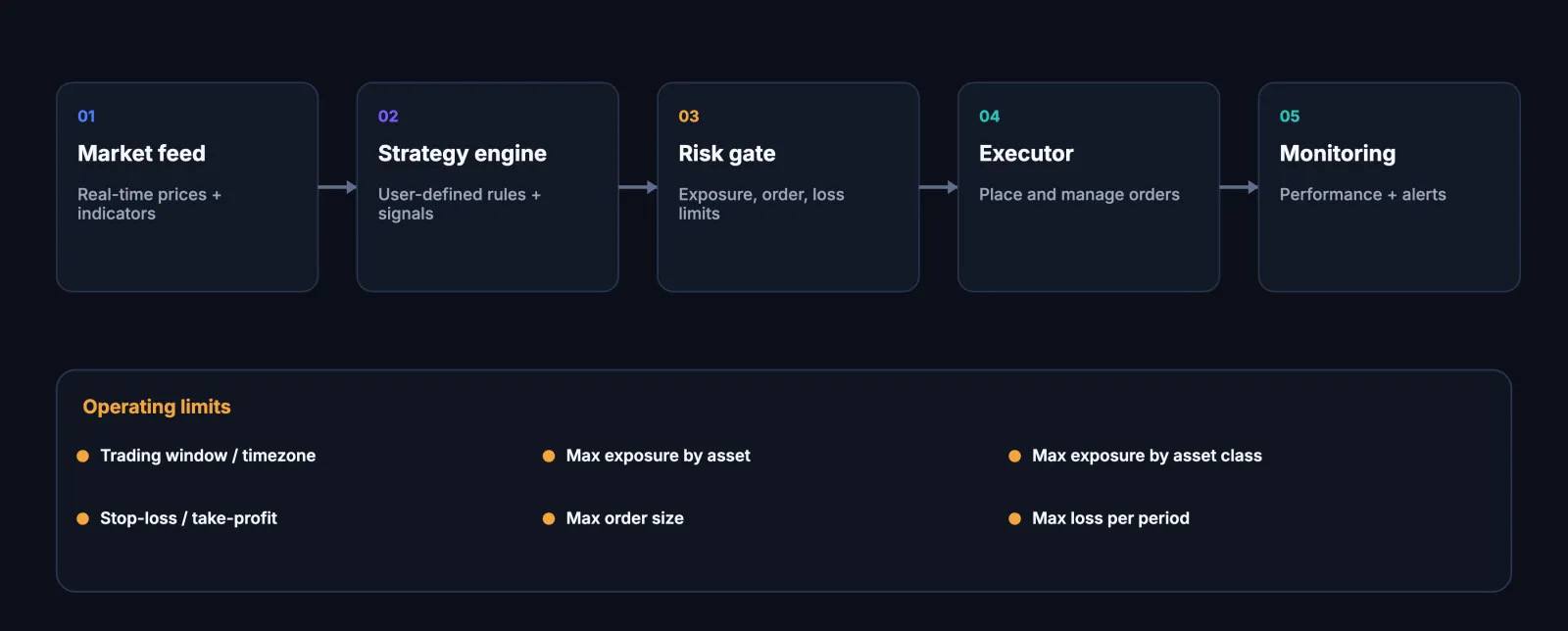
The hours or time frames in which the bot may operate, in a chosen time zone.
A cap on the bot's dollar exposure, per asset and per asset class.
Auto-sell when a stop loss hits, by a dollar value or a percentage of units.
A maximum order size, in monetary value or quantity of assets.
The most the bot may lose in a time frame from its initial position, absolute or relative.
Hypothesis 1
Hypothesis 2
What users do today
Users analyse, trade and manage on their own: time-consuming, emotional, limited by skill and execution speed.
Human advice and portfolio management: costly, subject to personal bias, and hard to reach.
Replicating experienced traders: a risk of following blindly, unreliable traders, limited customization.
Kinds of competitor
| Type | Examples named | Key strengths | Challenges |
|---|---|---|---|
| Robo advisors | Wealthfront, Betterment, Wealthsimple | Automated portfolio management, low fees | Limited customization, algorithm dependency |
| Algorithmic trading platforms | MetaTrader, NinjaTrader, QuantConnect | Advanced analytics, backtesting capabilities | Complexity, programming skills required |
| Copy trading platforms | eToro, ZuluTrade, CopyTrade | Access to proven strategies, social trading | Dependency on others' strategies, risk of losses |
| Self-directed trading platforms | Robinhood, TD Ameritrade, Interactive Brokers | Control over trading decisions, research tools | Learning curve, time commitment |
| Traditional financial advisors | Charles Schwab, Fidelity Investments, Vanguard | Human expertise, personalized advice | Cost, availability, subjective advice |
Tiered plans (basic, standard, premium), billed monthly or annually.
A fee per trade, with lower fees for higher volumes.
A share of profits, or fees tied to performance benchmarks.
A fixed monthly fee, or a one-time setup fee.
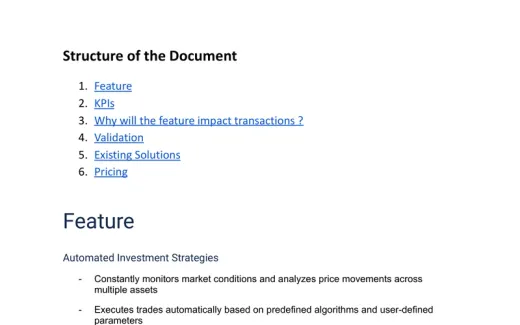
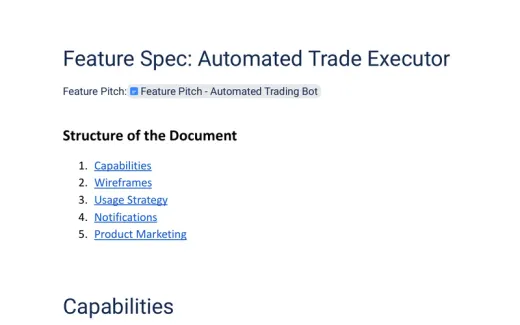
The four models the pitch lists. It does not choose between them. The documents themselves:open the pitch (PDF, opens in a new tab) andopen the spec (PDF, opens in a new tab).
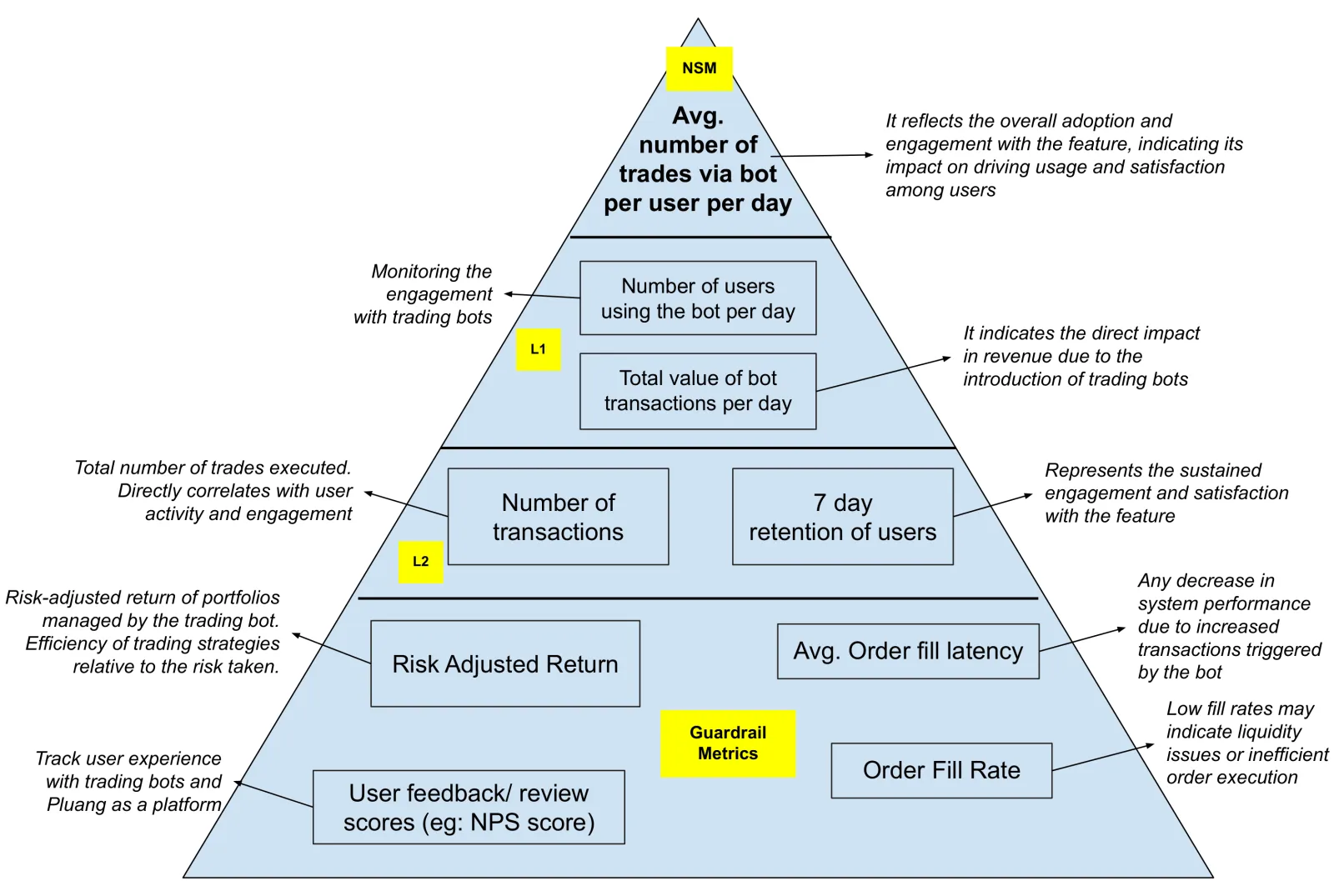
Primary goal
The launch is meant to get more users trading by introducing bots, so engagement is the goal the metrics are built around. The pitch expects the bot to give users peace of mind: positions across time zones and asset categories become easy to monitor.
Level 1
The brief required one metric to be transaction value. Total value of bot transactions per day sits at Level 1, beside the number of users using the bot per day: the direct read on revenue.
Guardrails
| Phase | Team | Activities and objectives | Dependencies |
|---|---|---|---|
| 1. Planning and preparation | Product | Define user needs, personas, market research and regulatory constraints | Legal team, user studies |
| Engineering | Turn product requirements into functional requirements; design the system for efficient implementation | Sync with product on required capabilities | |
| Design | Turn functional requirements into wireframes | Requirements definition from product | |
| 2. Development and prototyping | Product and Engineering | Design algorithm frameworks and investment logic; user data analysis | Regulatory approvals, backend development |
| Design | Create UI and UX flows | Requirements definition from product | |
| 3. Testing and iteration | QA | Conduct usability testing and gather feedback | Development completion |
| Engineering | Refine algorithms and optimize performance on user feedback | Usability testing feedback from the product team | |
| 4. Launch and initial rollout | Marketing and Product | Adoption collateral, go-to-market sync, success and guardrail metrics, usage analytics | Go-to-market development, user education collateral |
| Engineering | Plan and execute a phased rollout | Backend infrastructure readiness | |
| 5. Optimization and scaling | Product | Monitor adoption and feedback; gather insights for the next iterations | Adoption metrics, customer support feedback, analytics |
| Customer Support | Resolve customer queries; collate feedback and report issues to product | A stabilized feature launch | |
| Engineering | Monitor system health; optimize algorithms on real-time analytics and feedback | Feature stabilization |
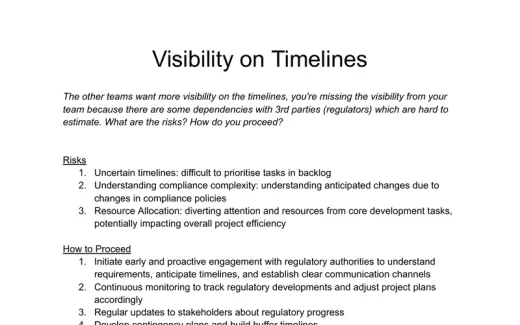
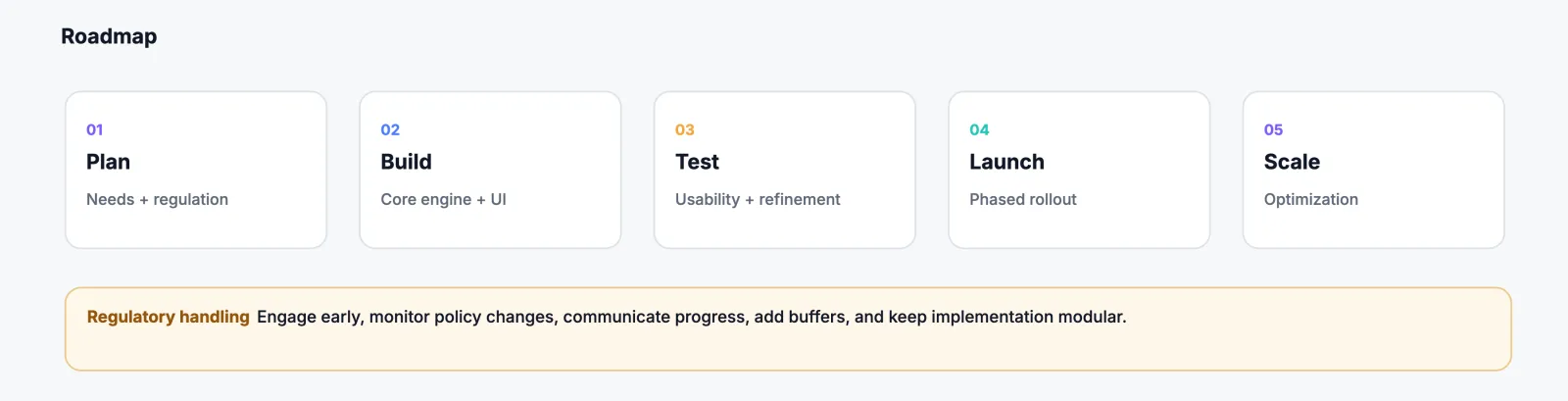
Task 2, as givenThe other teams want more visibility on the timelines, and that visibility is missing because of dependencies on third parties (regulators) that are hard to estimate. What are the risks? How do you proceed?
Risks
Tasks in the backlog become hard to prioritize.
Anticipated changes have to be understood as compliance policies shift.
Attention and resources drift from core development, which can hurt overall efficiency.
How I would proceed
01
Understand requirements, anticipate timelines and set up clear channels.
02
Track regulatory developments and adjust the plan as they move.
03
Keep stakeholders updated on regulatory progress.
04
Write contingency plans and build buffer into the timelines.
05
Internal teams, stakeholders and regulators work in the open, so expectations stay managed.
06
Modular features mean a rule change touches a smaller section of code.
Launch PR note, as submitted
Pluang introduces its groundbreaking Automated Trading Bot, revolutionizing how users manage investments effortlessly. Powered by cutting-edge algorithms, the bot offers real-time market analysis and automated trading strategies tailored to individual preferences. This innovative tool enhances accessibility and precision in financial decision-making, reinforcing Pluang's commitment to empowering users with sophisticated yet user-friendly fintech solutions. With seamless integration and robust security features, the Automated Trading Bot marks a significant leap forward in democratizing investment opportunities across Indonesia. Explore this transformative tool today and elevate your investments
The PR note is part of the exercise, written as if the feature had launched. Nothing in this case was built or shipped by Pluang.
Every source document, unedited. Each is also linked from the section it supports.
Download the original documents (zip)PDF · Jun 2024
PDF · Jun 2024
PDF · Jun 2024
Image · Jun 2024
PDF · Jun 2024
PDF · Jun 2024