Assignment 1
Core loop evaluation
- Run a Vyry Quest 4.2 quest as a three-person party
- Ask two peers the same five questions afterwards
- Summarise their answers, with a recording from each
- Write a one-pager: PM analysis, peer insights and a reflection
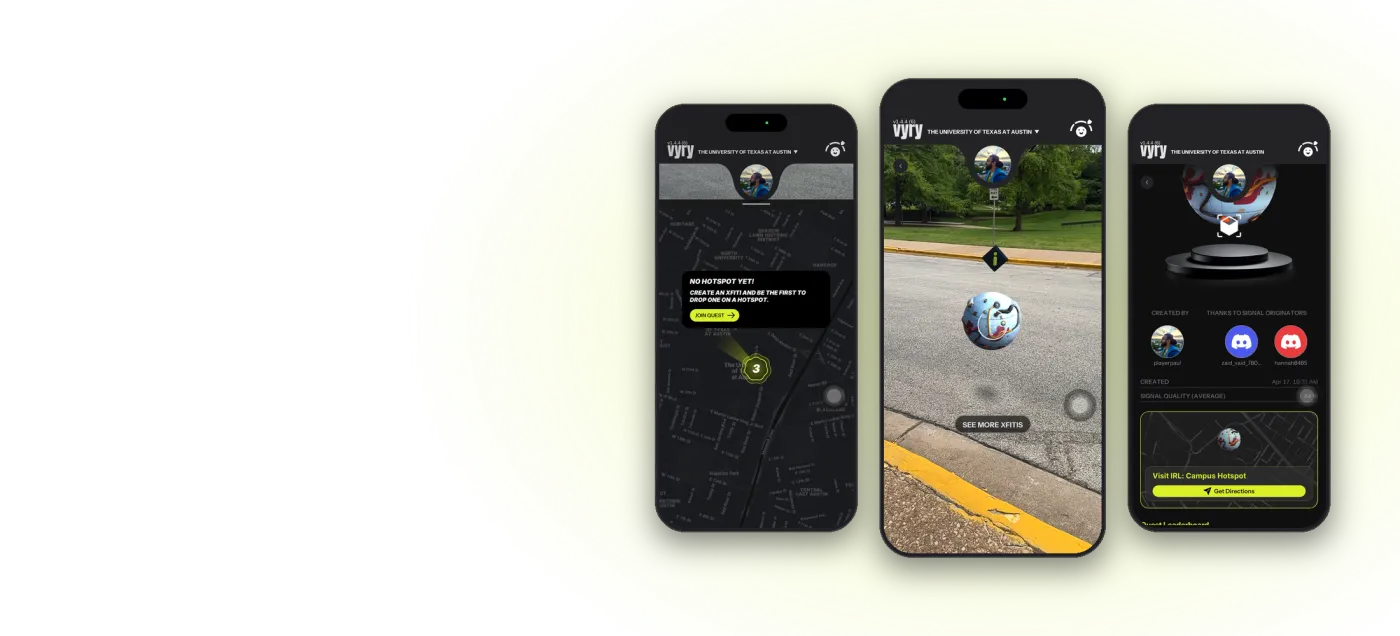
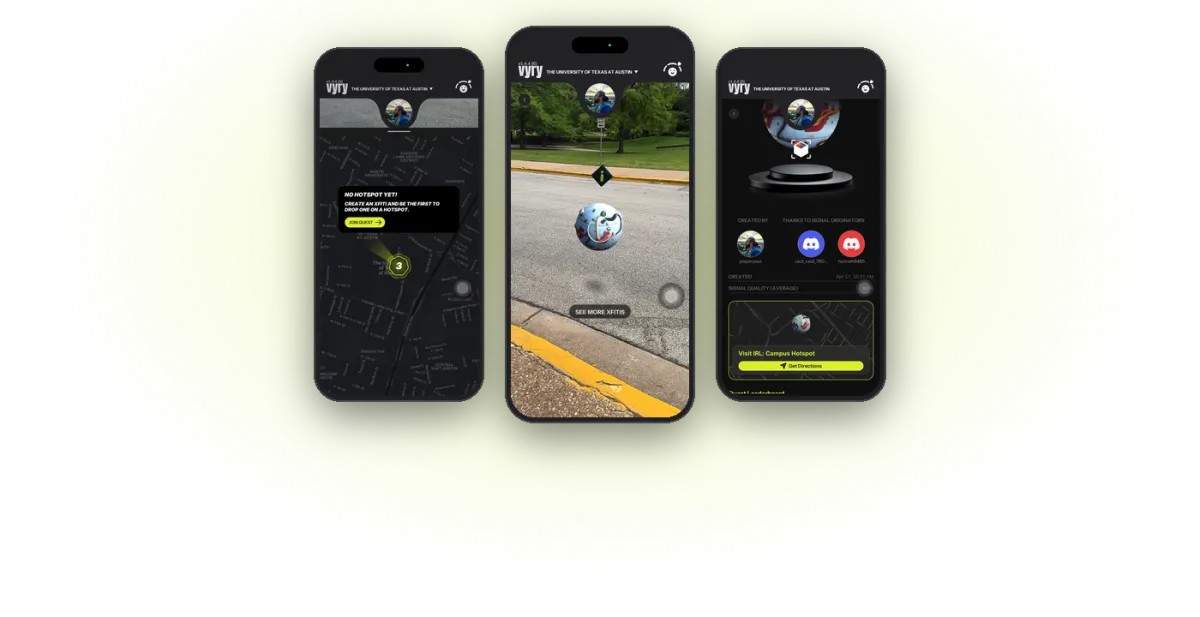
Product case study
Getting to the fun part of a campus quest sooner.
Two PM intern assignments on Vyry Quest 4.2, a multiplayer quest played on campus. Running it with two peers showed a loop that works but explains itself too late, so I ranked five fixes with DHM and wrote the PRD, then tried a hotspot in person.
Assignment 1
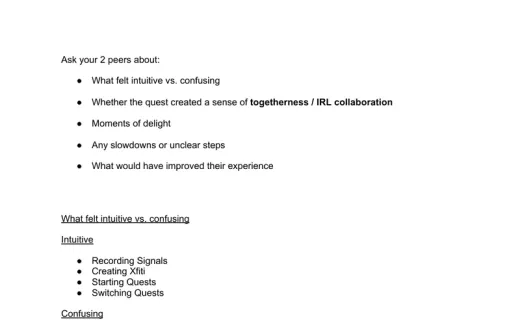
Asked of each peer
Assignment 2
Under ExtrasThe one-pager closes with three extras: a bug report on existing usability issues, a prioritization of the challenges to solve next, and a detailed PRD for fixing them. Sections 04 to 06 come from those.
Term
A scavenger-hunt-like activity done by a small party. The PRD's primary users are university students in groups of three.
Term
What players record, and then go and find around campus. Signals are public: anyone in the same world can view them.
Term
The co-created output of a quest. After the hotspot visit I called it social digital graffiti: a digital artifact left in the real world.
Term
The shared finale a quest builds toward, the payoff of the loop.
Term
Campus-specific or World. A party drawn from different universities may need World instead of its institute's channel.
Term
A place where players anchor an Xfiti, return later, decompose it, leave a dash signature and see who else has been there.
Pieced together from my own documents. A first-time player gets no such glossary, which became the main finding.
PM analysis
The multiplayer quest has a real social core. Once the group understands the flow, it creates movement, coordination and a shared goal that feels different from a typical mobile app.
PM analysis
The biggest issue is not the loop but activation clarity: what an Xfiti is, how to find the right quest, when to pick a campus channel over World, and why to care early on.
PM analysis
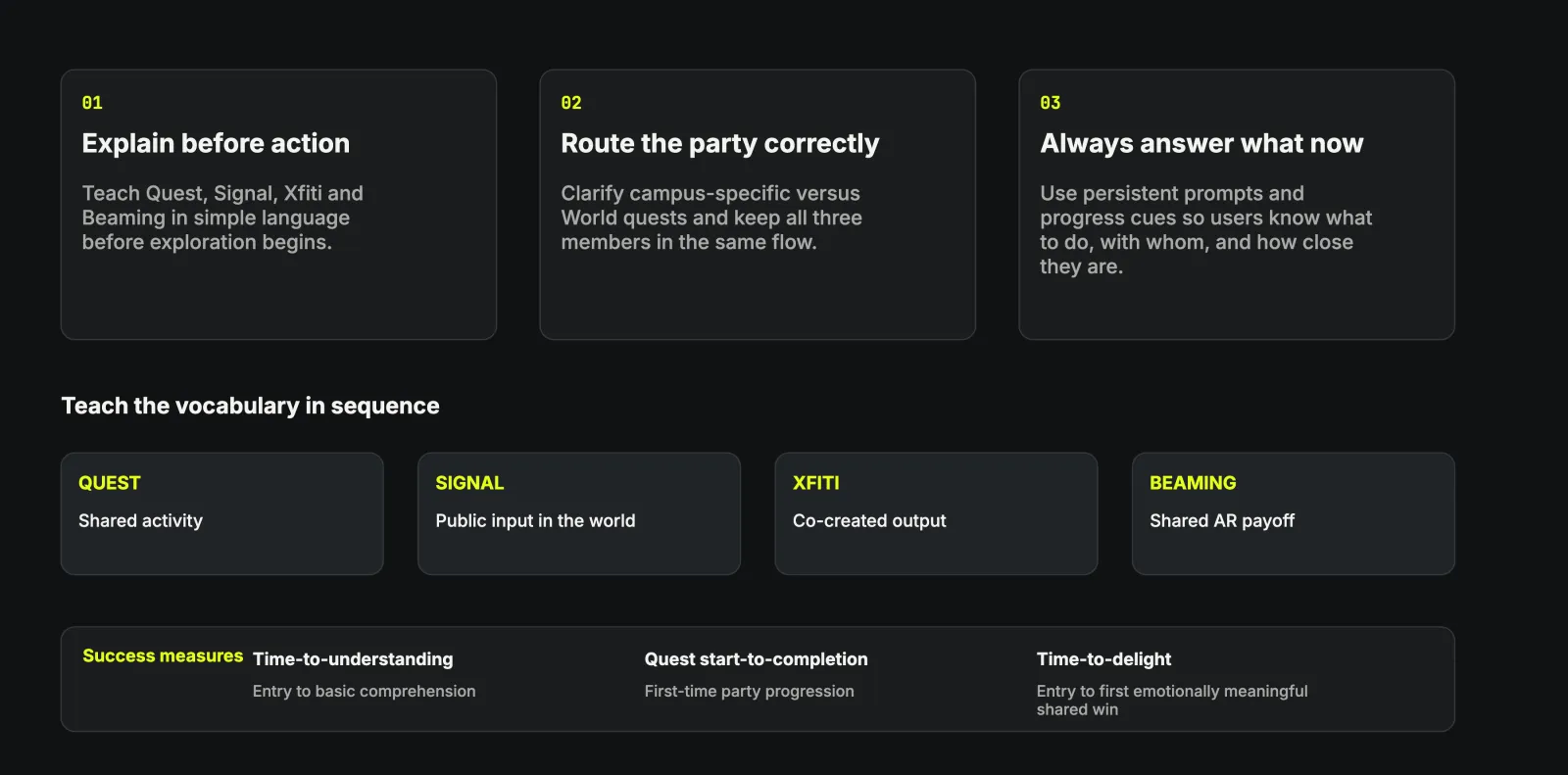
A 3-step onboarding layer before users act, and quest entry and next-step prompts that always answer: what do I do now, who am I doing it with, and how close am I to done.
What surprised meThe product's strongest value only appeared after we pushed through the weakest part of the experience. That usually signals a good underlying mechanic paired with weak onboarding, rather than a broken concept.
The ideaFive changes around Vyry Quest's loop, not to it, so a new user understands the quest in the first minutes: onboarding, quest routing, next-step guidance, Signal visibility and a focus mode.
01
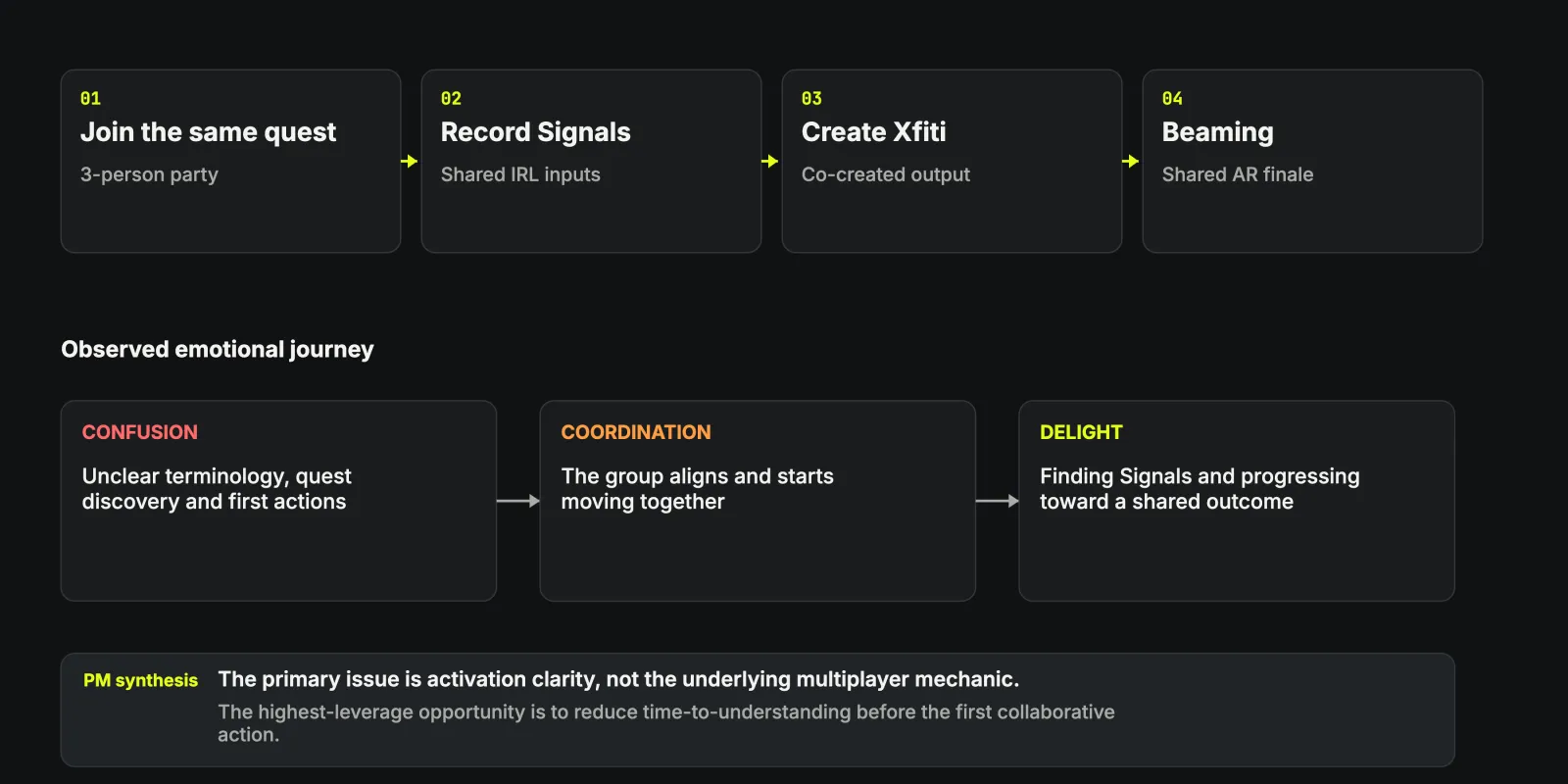
I ran a quest with two peers, then went to a hotspot in person, and wrote up what each showed.
The problem02
New users do not immediately understand what an Xfiti is, how Signals work or which quest type to choose, so the shared payoff arrives late.
The problem03
My notes and the two peers' own words show what felt intuitive and what stayed confusing until the group worked it out.
The research04
Five issues were rated on Delight, Hard to copy and Margin moving, and three rank P1 as one package.
The ranking05
Guided onboarding, clearer quest routing, persistent next steps, Signal visibility and a focus mode, none of them touching the core loop.
The five changes06
Quest completion rate to Beaming, with four supporting metrics. All proposed, none measured.
The metricsThe problem
New users do not immediately understand what an Xfiti is, how Signals work, which quest type to choose or what to do next. The social value is delayed, and they rely on group trial and error to progress.
The opportunity
If users understand the what, why and what now of the quest in the first moments, the product surfaces its strongest value much faster: shared movement, coordination and a co-created payoff.
Why it matters to the business
Early confusion raises drop-off before the first moment of delight. Clearer onboarding should raise quest starts and the share of users who reach Beaming.
The moat is physical movement, multiplayer coordination and a shared payoff. If users cannot reach it smoothly, it stays hidden.
A cleaner first run should make users likelier to invite peers, replay quests and call the experience social, not confusing.
Clearer guidance should cut support questions and repeated explanation across universities and quest types.
Assumed throughoutThe quest mechanic is promising and the issue is activation clarity; cutting time-to-understanding in the first two minutes will lift starts, completion and delight; and simpler language, routing and guidance can ship without changing the core social mechanic.
| Proposed solution | What it does | Pain points addressed |
|---|---|---|
| Guided first-run onboarding | A 3-step layer that explains the quest goal, core terms and the shared Beaming payoff before users begin. Simple language first, branded language second. | Unclear terminology, weak motivation to start, delayed understanding of product value |
| Quest routing and entry redesign | Make the campus-specific or World choice explicit, simplify quest discovery, and state why a user is seeing each option. | Difficulty finding the right quest, uncertainty about where to begin, group setup friction |
| Persistent next-step guidance | At every stage, answer: what do I do now, who am I doing it with, and how close are we to completion? | Mid-flow confusion, stalled progression, heavy reliance on peer interpretation |
| Signal visibility clarification | Explain clearly whether Signals are public, private, or shared within a world or quest context. | Mismatched mental models and uncertainty around content visibility |
| Main-journey focus mode | Hide or de-prioritize distracting non-core surfaces during the primary activation flow. | Cognitive overload and attention leakage during the first-run experience |
Limits
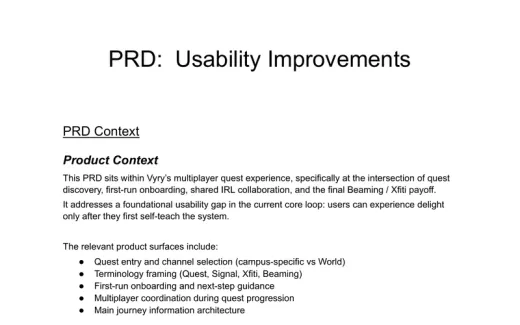
The PRD does not redesign the core quest mechanic; it improves activation and comprehension around it.
It does not solve long-term content depth, replay loops or community growth mechanics beyond first-run activation.
Some confusion may still come from quest design quality, not only UX clarity.
Further iteration may be needed by campus type, party composition or quest complexity.
| Trend | What it means | Where Vyry stands | Implication |
|---|---|---|---|
| Low-friction onboarding expectations | Users expect consumer products to explain themselves in seconds, not minutes | Depends on peer deduction and experimentation | Front-load orientation and shorten time to first success |
| Shared mechanics beat solo ones when the payoff is obvious | Group products work when roles, goals and progress are visible | The shared payoff is strong, but not explained up front | Make collaboration visible before the first action |
| Plain language beats branded terms during activation | Novel vocabulary can add identity later but adds friction on first use | Terms like Xfiti and Signal are memorable only once understood | Pair branded terms with simple explanations, or stage them |
| Contextual guidance beats static discovery | Users learn faster from in-flow prompts than from searching across screens | Quest discovery and next steps feel under-guided | Use what-to-do-now prompts inside the journey |
| Focus is critical during early activation | Non-core information distracts while the primary job is still unclear | Feature-request visibility and unclear screens add noise | Reduce or hide distracting surfaces during the first-run flow |
Borrowed from adjacent products
| Borrowed from | What they do | Impact | Opportunity |
|---|---|---|---|
| Multiplayer mobile games | Explain the objective, role and first win within the first minute | Faster activation and clearer motivation | A lightweight tutorial that explains the group goal before exploration begins |
| Scavenger hunt and geolocation apps | Use progress cues, nearby prompts and contextual nudges | Fewer what-now moments | Clearer waypointing, progress feedback and next-step prompts |
| Consumer onboarding practice | Introduce one concept at a time instead of the full vocabulary | Lower cognitive load and higher completion | Teach Quest, then Signal, then Xfiti and Beaming, in sequence |
| Collaboration tools | Clarify who is involved and what each participant is expected to do | Shared accountability and togetherness | Show party state, shared goal and progress at the top of the quest |
| Phase | Team | Activities and objectives | Dependencies |
|---|---|---|---|
| 1. Diagnose and define | Product | Map the first 2-minute user journey, identify key drop-off moments and define success metrics for activation | Participant feedback, product observation, quest flow audit |
| Design | Translate confusion points into revised onboarding copy, routing concepts and progress states | Product problem statement | |
| Engineering | Audit current quest entry points, event instrumentation and surfaces that can support prompts and tooltips | Scope alignment with Product and Design | |
| 2. Design and specification | Product | Specify the onboarding sequence, quest selection logic and success events | Design concepts and engineering feasibility |
| Design | Prototype the first-run tutorial, route selection and in-flow guidance states | Approved feature scope | |
| Engineering | Build a lightweight onboarding framework and support for context-aware prompts | Design specs | |
| 3. Development and prototyping | Product and Research | Run rapid usability tests with small student groups; compare time-to-understanding and completion | Working prototype |
| Engineering | Instrument funnel metrics across quest start, first Signal, Xfiti creation and Beaming | Prototype integrated in app | |
| 4. Launch and initial rollout | Product | Ship to limited cohorts; monitor confusion signals, completion and qualitative feedback | Stable release candidate |
| Growth and Campus Ops | Collect campus-specific learnings and check whether World versus institute routing still confuses users | Launch monitoring |
Launch PR note, as written in the PRD
We are improving the Vyry Quest experience by making the first run easier to understand and easier to start. New onboarding will explain the quest goal, core terms, and shared payoff in simple language, while updated routing will help parties get into the right quest faster. We are also adding stronger next-step guidance throughout the journey so users always know what to do, who they are doing it with, and how close they are to completion. Together, these changes aim to reduce confusion, surface the social magic earlier, and increase quest completion without changing the core multiplayer mechanic.
The PR note is part of the exercise, written as if the changes had shipped. The PRD is my proposal, not a record of anything Vyry built.
4 notes
Confusing · 5 of 10
Confusing · 5 of 10
Togetherness?Yes, once we figured out what to do.
Moment of delightOnce we figured out what needed to be done: going around places trying to find the signals.
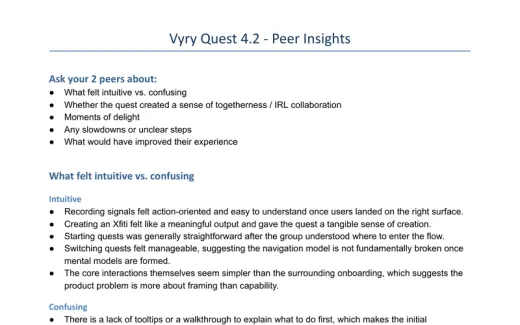
My notes from the two peers who ran the quest with me, plus my own run. A sample of two: directional, not a measurement. Open the notes (PDF, opens in a new tab).
My overall experience with the Vyry quest started out a little confusing, but once our group understood the flow, it became much more engaging. A few things felt intuitive, like recording signals, creating the Xfiti, and moving between quests once we knew where to go. The most enjoyable part for me was actually walking around together trying to find the signals, because that was the moment when the product started to feel social and different from a normal app experience. I also liked that the end goal felt shared instead of individual. Where I struggled most was in the beginning, because the app did not explain what an Xfiti was, how quests were supposed to work, or why I should care right away. I think a short walkthrough and clearer guidance on the first few steps would make the experience much smoother and help users reach that fun collaborative part much faster.For me, the biggest issue with the Vyry quest was not the core idea, but the clarity of the early experience. The concept became interesting once we figured it out as a group, and at that point it did create a real sense of togetherness because we had to coordinate in person and work toward the same outcome. But the app made us do too much interpretation on our own. I was not sure what an Xfiti meant, I did not immediately understand that signals could be public, and it was not always obvious how to find or start the right quest, especially campus-specific versus World quests. I also found some screens distracting, like seeing things such as feature requests during the main journey. The product has a strong collaborative mechanic underneath it, but I think it needs simpler language, better onboarding, and clearer next-step prompts so users do not get stuck before the delight actually begins.Each peer's statement in full, as it appears in my documents. Quoted without names; a sample of two.
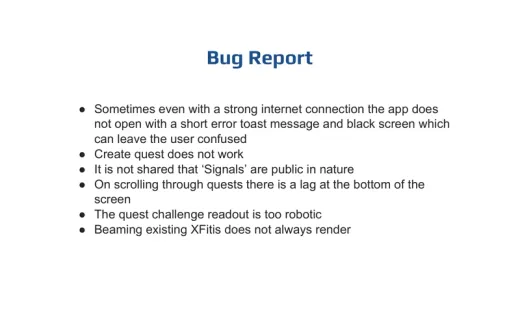
Bug 01
Sometimes, even on a strong connection, the app does not open: a short error toast and a black screen, which can leave the user confused.
Bug 02
Create quest does not work.
Bug 03
Nowhere is it shared that Signals are public in nature.
Bug 04
Scrolling through quests lags at the bottom of the screen.
Bug 05
The quest challenge readout is too robotic.
Bug 06
Beaming existing Xfitis does not always render.
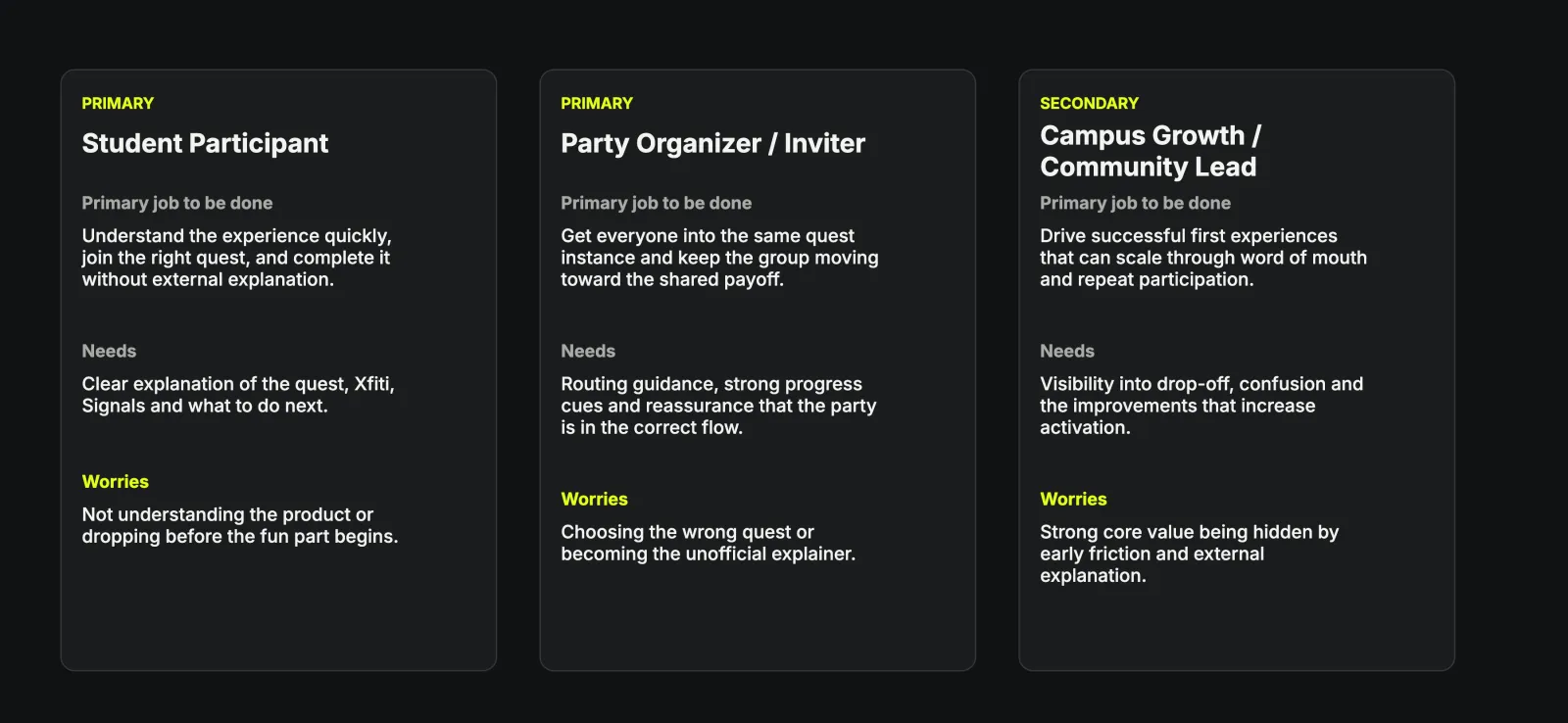
From the PRD: personas based on the assignment brief, direct product observation and recurring pain points in the peers' feedback.
Primary
Coordinator
Secondary
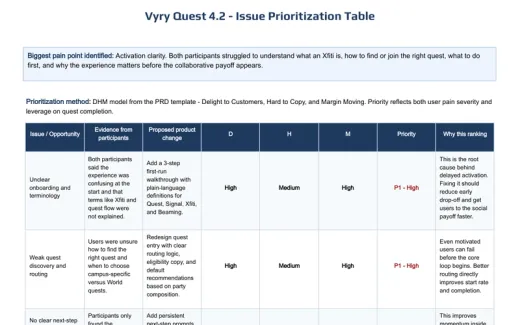
Biggest pain pointActivation clarity. Both peers struggled to understand what an Xfiti is, how to find or join the right quest, what to do first, and why the experience matters before the collaborative payoff appears.
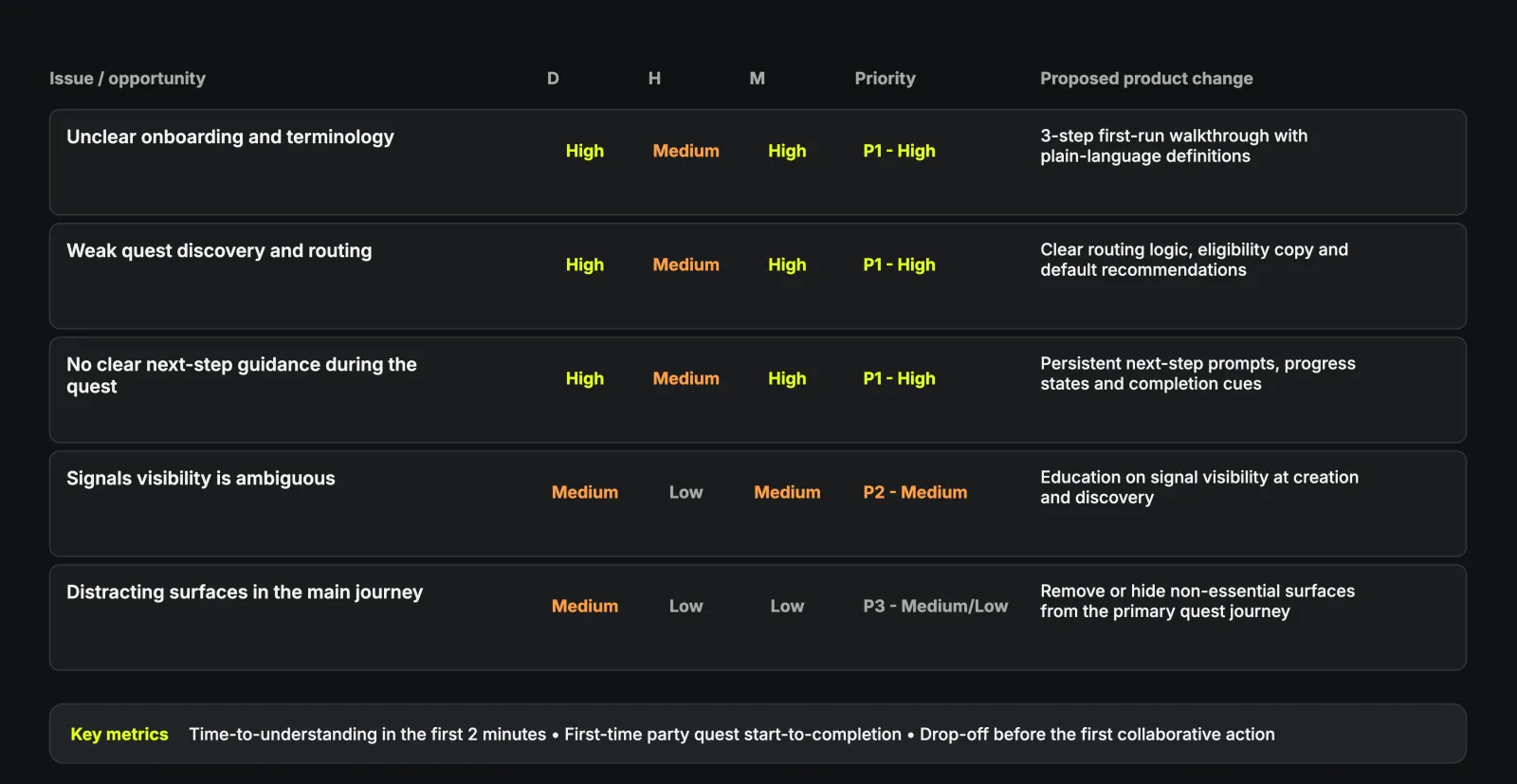
The ratings are the table's; the proposed changes are shortened here, and why each issue ranks where it does is in the document. The PRD's shorter table rates next-step guidance Medium on margin, and its priority is High in both. Open the table (PDF, opens in a new tab).
D
How much the solution enhances user experience and satisfaction.
H
The level of difficulty competitors would face in replicating the solution.
M
The potential impact of the solution on revenue generation or cost savings.
How priority followsHigh priority scores high across all three; medium is a mix of high and medium; low scores lower on one or more. Here priority reflects both how severe the pain is and its leverage on quest completion.
SequencingShip the three P1 items together as the activation package for the next release. Then address signal visibility and distraction cleanup as secondary clarity improvements.
Objective of the launchReduce time-to-understanding and increase the share of users who reach the first collaborative payoff.
Proposed metrics from the PRD's KPI pyramid, not measured results.
Two terms the PRD defines
How quickly a new user understands what the product is, why it matters and what to do next.
The time between entry and the first emotionally meaningful shared win.
Stills from my own screen recordings. The app is Vyry's product, not my design.
1 / 5
Step 01
The campus map opens on a card: no hotspot yet, create an Xfiti and be the first to drop one on a hotspot. A lime marker on the map reads 3.
Step 02
Opening an Xfiti shows who created it, whose Signals went into it, when it was made and its average signal quality, then an invitation to visit it in person.
Step 03
At the spot the camera opens with one instruction: move your phone to detect the ground.
Step 04
The Xfiti appears in the street with an info marker above it and one button, See more Xfitis. Nothing says what to look for or what decomposing is.
Step 05
See more Xfitis opens a tray of other Xfitis as thumbnails over the camera view, with the first Xfiti still in frame.
Clip · 12.9 s, no sound
Standing in the street, I move toward the Xfiti until it fills the screen, then back, and a tray of other Xfitis appears along the bottom.
Stays on screen
Move your phone to detect the ground stays over the Xfiti from the first frame to the last, even after the Xfiti is in place.
What worked
Walking to the hotspot felt like a meaningful part of the experience rather than friction: it made the product feel physical, social and location-based, not like another mobile app interaction.
What did not land
I needed clearer cues on what to look for, what decomposition meant and what had changed after I interacted with the Xfiti. I also could not work out the interactions needed to complete a dash signature.
Strongest feeling
Someone had left a digital artifact in the real world and I could discover it later. The earlier quest output was now connected to an actual place.
Would I do it again?Yes, if the hotspot had stronger context, clearer instructions and a more obvious emotional or social payoff after decomposition.
A friend, watchingInteresting from the outside, because the phone felt connected to the physical place; slightly awkward at moments, because I was scanning around without knowing whether I was doing the right thing.
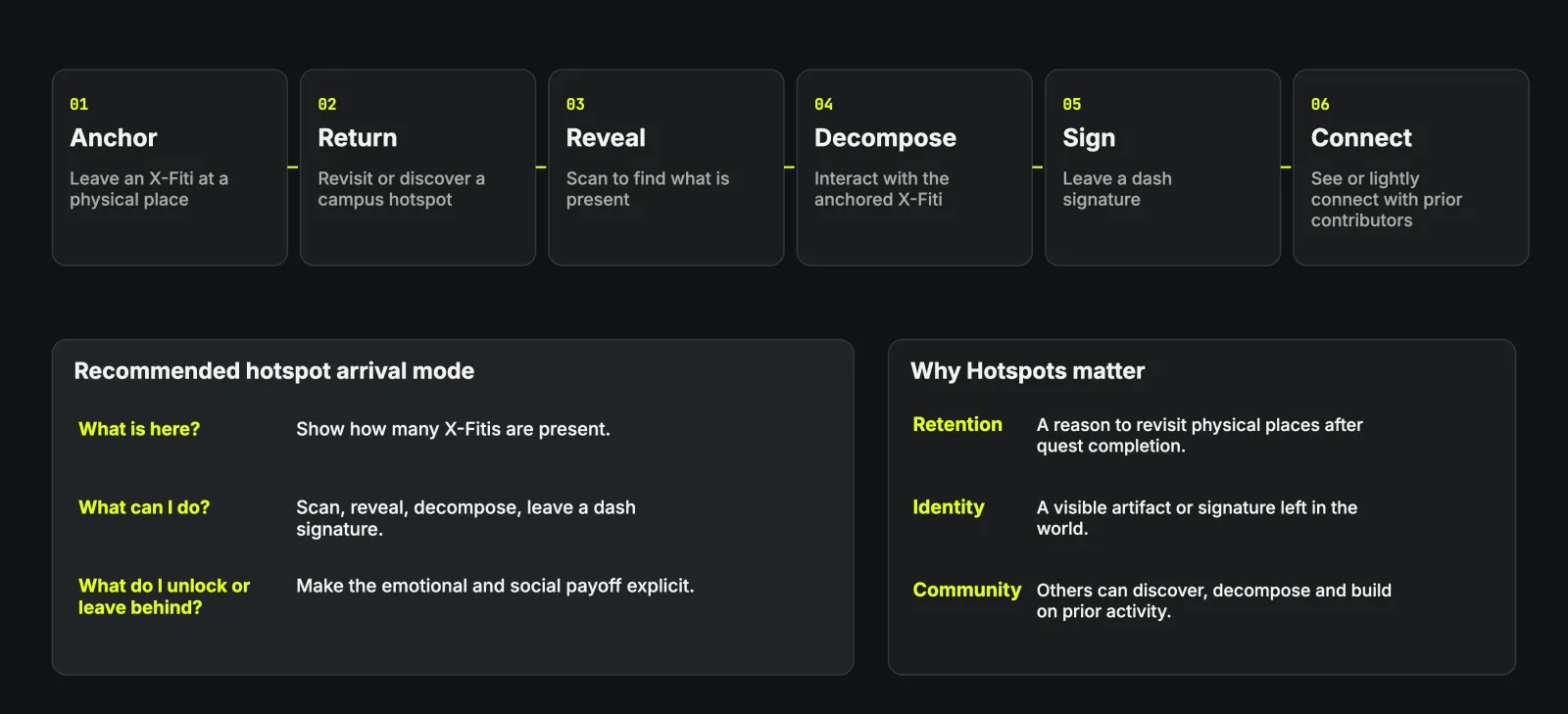
Example copy, from my write-up
Scan to reveal, decompose it, and leave your dash signature. It would reduce uncertainty and make the in-person moment feel intentional instead of exploratory in a confusing way.
Also suggested
A way to connect directly with the players who invested time in placing Xfitis at the hotspot, to create a feeling of community.
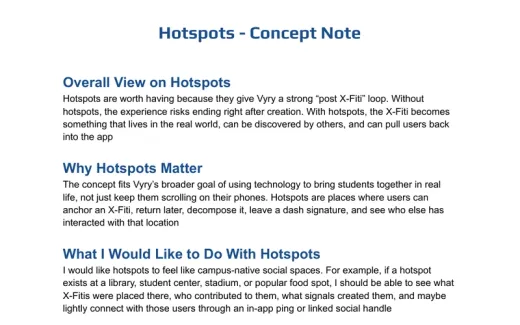
Overall viewHotspots are worth having because they give Vyry a strong loop after the Xfiti. Without them the experience risks ending right after creation; with them the Xfiti lives in the real world, can be discovered by others and can pull users back into the app.
Closest existing behaviorSimilar in spirit to Pokémon Go gyms, with more emphasis on co-creation, social discovery and campus belonging. A hotspot should make users curious enough to go there, interact, and feel connected to the people who were there before them.
A hotspot must answer
A hotspot must answer
A hotspot must answer
RecommendationA strong idea for after an Xfiti is created, whose value needs to be made clearer. If Vyry answers those three questions, hotspots could become the bridge between one-time quest completion and repeat, real-world engagement.
The note in full: open the concept note (PDF, opens in a new tab).
Source documents as written; the PRD has only the targets of its Google links removed. Each is linked from the section it supports.
Download the original documents (zip)Research notes
Research synthesis
Bug report
Prioritization
PRD
Concept note